New Gas Fittings LCC27

New LPG Gas Bottle Fittings have arrived

Here's what you need to know.

The New LCC27 LPG Gas Cylinder Fittings for Australia

Here’s a quick video from Platinum Campers explaining everything you need to know about the new gas fittings. 

LCC27 fittings have improved safety features

LPG cylinders will be coming out soon with a new fitting called a LCC27. There’s a good chance that your current gas bottles use a Type 21 or POL connection.

LCC27 fittings offer improved safety features, including an easy-to-use right-hand threaded external ACME connection, and a back check valve that must be engaged before gas can flow. In addition, there is a thermal cut-out on the LCC27 appliance connection.

LCC27 Connector LPG Gas Fitting Drawing
LCC27 Connector LPG Gas Fitting
POL Connector LPG Gas Fitting Drawing
POL Connector LPG Gas Fitting

What you Need to know about the new Gas Fittings

Do I need an Adaptor?

The new gas regulations state that you cannot use an adaptor with the new LCC27 gas fittings. However – the new bottles are backwards compatible to appliances with POL connections – so you won’t need an adaptor anyway. You will not need to change anything to use the new gas bottles with your current appliances (Your BBQ will still work!) 

However – New appliances, like camper trailers from now will have the new LCC27 gas connection. And these are not backwards compatible with your old gas bottles. So, if purchasing a gas appliances (including camper trailers) from now, you will need to get the new bottle. 

POL connection phasing out

Over the next 10 years, the LCC27 will take over from the POL Connection across the board. Leisure gas cylinders have a 10 year test cycle, so by 2031 – you will find the LCC27 is the main bottle in use. 

Still safe to use?

Yes, your current gas appliances with a POL connection are still safe and reliable for use, and will still plug into the new bottles. So on your next swap – look out for the new bottle and get yourself future proofed! 

LCC27 valve to LCC27 appliance
LECC27 Valve to POL appliance
Pol Valve to Pol Appliance
Pol Valve to LCC27 appliance
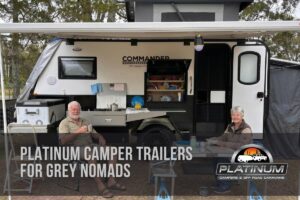
Platinum Camper Trailers for Grey Nomads

Platinum Camper Trailers for Grey Nomads

The best Platinum camper trailers for grey nomads are the Commander Hybrid and the Discovery E1, with the General S4 a strong value pick for couples who want easy access and quick setup. These models combine off-grid capability, comfortable living space, and manageable towing weights, the three things that matter most when you are travelling for months at a time. Grey nomads, retired or semi-retired Australians aged 50 and over who tour the country for extended periods, are one of the most committed groups on the road. Older Australians travelling domestically in self-sufficient recreational vehicles for extended periods have been referred to as grey nomads for more than two decades, with the term applying to those who tour for a minimum of three months. Choosing the right rig is the difference between a relaxed Big Lap and a trip cut short by setup hassle or a poorly matched tow vehicle. This guide breaks down which Platinum models suit the grey nomad lifestyle, what to look for in setup and power systems, and how to match a camper to your vehicle legally and safely. Key Takeaways What Makes a Camper Trailer Right for Grey Nomads? The right camper trailer for grey nomads prioritises easy setup, off-grid self-sufficiency, comfortable sleeping and seating, and a towing weight your vehicle can handle for thousands of kilometres. Comfort and reliability outrank raw size, because most grey nomads travel as couples and cover long distances at an unhurried pace. Extended travel is the defining feature of this lifestyle. Retirees travel for longer and spend more nights per trip than any other group, sustaining regional tourism outside peak holiday periods. A camper that is quick to pitch and pack means less physical strain at the end of a long driving day, which becomes more important the longer you stay on the road. What’s Up Downunder Self-sufficiency is the second priority. Many grey nomads prefer free camping and roadside stops over paid parks, so a camper needs onboard water, solid battery storage, and a kitchen that works anywhere. If you are weighing your options, our guide to whether camper trailers are still worth it covers the value case in detail. The market backs this up. By 2021, more than 750,000 recreational vehicles were registered in Australia, and tourism data showed 11.8 million domestic camping and caravanning trips in a single year, with 29% of those taken by people aged 55 and over. According to the Caravan Industry Association of Australia, this segment remains a backbone of regional travel. Best Platinum Camper Trailers for Grey Nomads The standout choices are the Commander Hybrid for off-grid comfort, the Discovery E1 for living space, and the General S4 for accessible, affordable touring. Each suits a slightly different travel style and budget. The Commander Hybrid blends the comfort of a caravan with the agility of a camper trailer, making it the premium pick for grey nomads planning long off-grid stints. It offers hard-sided protection, a permanent bed, and the storage capacity needed for weeks between resupply. See the Commander Hybrid for full specifications, and read how a hybrid camper trailer lifts the touring experience. The Discovery E1 is a forward-fold hard floor camper that maximises living space and comfort. Its generous internal area and quick setup make it ideal for couples who want room to spread out without stepping up to a full caravan. View the Discovery E1 to compare layouts. The General S4 is a step-through soft floor camper built around accessibility and storage. The step-through design reduces the bending and climbing that can be a real consideration for older travellers, and it sits at a friendlier price point. Explore the General S4 for details. For couples who value the fastest possible setup, the rear-fold Chase S5 is purpose-built for compact towing and quick camps, a strong fit for those who relocate often. Our breakdown of the best camper for couples puts these options side by side. Model Type Best for grey nomads Setup Why it suits the lifestyle Commander Hybrid Hybrid Extended off-grid travel Fast Caravan comfort, off-road agility, big storage Discovery E1 Forward fold hard floor Couples wanting living space Quick Maximum internal comfort, family-friendly General S4 Step-through soft floor Easy access, value Moderate Step-through entry, strong storage, affordable Chase S5 Rear fold hard floor Frequent movers Very fast Compact towing, rapid setup Cadet SE Soft floor Lightweight budget touring Moderate Light, affordable entry point Easy Setup and Low-Maintenance Living For grey nomads, a camper that sets up in minutes and needs little upkeep is worth more than extra square metres. Hard floor and hybrid designs pitch faster than traditional soft floor campers, which reduces fatigue on travel-heavy days. Platinum’s rear-fold and forward-fold models are engineered for speed, with the bed and main living area deploying as the camper opens. If setup time is your deciding factor, see which is the quickest to set up across the range. Low maintenance keeps you on the road instead of in a workshop. Regular servicing of bearings, brakes, and suspension is essential when you are covering tens of thousands of kilometres. Our guide on how often to service your camper sets out a sensible schedule for long-distance travel. Australian build quality matters here too. Platinum campers use a hot-dipped galvanised chassis, meaning the frame is coated in zinc to resist rust, and independent suspension, where each wheel moves separately for a smoother ride on rough roads. These features extend the camper’s working life across corrugated outback tracks. Off-Grid Power for Extended Free Camping Reliable off-grid power is non-negotiable for grey nomads who free camp, and the proven setup is solar panels paired with a lithium battery and a DC-DC charger. This combination keeps fridges, lights, and devices running for days without mains power. Solar is the primary source. A well-sized solar array recharges your batteries during daylight, and our overview of solar power explains how to match panel capacity to your usage. Storage is the other half. Lithium batteries hold more

Read More »
Platinum Campers Hitches

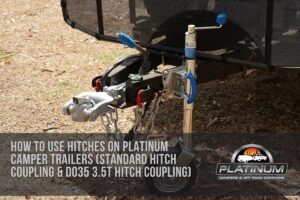
How to Use Hitches on Platinum Camper Trailers (Standard Hitch Coupling & DO35 3.5T Hitch Coupling)

Key Takeaways Introduction The hitch coupling is the single most critical connection between your tow vehicle and your camper trailer. Get it wrong, and you risk a dangerous separation on the road. Get it right, and you’ll tow with confidence across any terrain Australia throws at you. Platinum Camper trailers are fitted with either a standard 50mm ball coupling or the DO35 3.5T hitch coupling, depending on the model and its gross trailer mass. This guide explains exactly how each system works, how to connect and disconnect safely, and which hitch suits your setup. Whether you’re towing a lightweight Cadet SE to a coastal campground or hauling a fully loaded Commander Hybrid through corrugated outback tracks, this article covers everything you need. Hitch Systems on Platinum Camper Trailers Platinum Campers equips its trailers with hitches rated to match each model’s weight class and intended terrain. There are two systems you’ll encounter across the range. Standard Hitch Coupling (50mm Ball Coupling) is the most common trailer coupling in Australia. It clamps onto a standard 50mm tow ball fitted to your vehicle’s tow bar. This coupling is rated for trailers with an ATM up to approximately 2,000–2,500 kg, making it suitable for lighter soft floor and hard floor models like the General S4, Chase S5, and Quest E1. DO35 3.5T Hitch Coupling is a heavy-duty, off-road-rated coupling designed for trailers with an ATM up to 3,500 kg. Instead of clamping onto a ball, the DO35 uses a pin-and-coupling mechanism that locks onto a specialised receiver mounted to your vehicle. It provides greater articulation (360-degree rotation), improved shock absorption, and a more secure connection on rough terrain. This coupling is standard or optional on heavier models such as the Chariot E1, Discovery E1, and Commander Hybrid. According to Couplemate, the DO35 coupling reduces lateral stress on the tow bar by up to 50% compared to a standard ball coupling, which significantly lowers wear on both the vehicle and trailer chassis over extended off-road use. Quick Comparison: Standard vs DO35 Hitch Coupling Feature Standard 50mm Ball Coupling DO35 3.5T Hitch Coupling Max ATM Rating Up to ~2,500 kg Up to 3,500 kg Connection Type Clamps onto 50mm tow ball Pin locks into dedicated receiver Articulation Limited vertical/horizontal 360-degree rotation Off-Road Suitability Moderate Excellent Shock Absorption Minimal Built-in dampening Vehicle Requirements Standard 50mm tow ball and tow bar DO35-compatible hitch receiver Typical Platinum Models Cadet SE, General S4, Chase S5, Quest E1 Chariot E1, Discovery E1, Commander Hybrid Ease of Connection Simple clamp-and-lock Pin insertion and latch How to Connect a Standard 50mm Ball Coupling Connecting a standard coupling is straightforward, but rushing the process is where most mistakes happen. Follow these steps every time. Step 1: Position your vehicle. Reverse your tow vehicle so the tow ball is directly beneath the trailer’s coupling head. Use a spotter if possible. The coupling should be slightly above the ball height. Use the jockey wheel to adjust height as needed. Step 2: Lower the coupling onto the tow ball. Release the coupling latch (lift the handle), then wind down the jockey wheel until the coupling sits fully over the tow ball. You should hear or feel a distinct “click” as the latch engages. Step 3: Lock the coupling. Push the latch handle down firmly until it locks into position. Visually confirm the latch is fully closed. Many standard couplings have a locking pin or clip that prevents the handle from bouncing open during travel. Insert this pin every time. Step 4: Attach safety chains. Cross the safety chains under the coupling in an X pattern and attach each chain to the designated anchor points on the tow bar. According to Australian Standard AS 4177.4, safety chains must be rated to the trailer’s ATM and must be short enough to prevent the drawbar from hitting the ground if the coupling fails, but long enough to allow full turning. Step 5: Connect the electrical plug. Plug in the 7-pin or 12-pin flat connector to power your trailer’s lights, brakes, and any auxiliary systems. Test all lights (indicators, brake lights, tail lights) before departure. Step 6: Connect the breakaway cable. Attach the breakaway cable to a separate anchor point on the tow bar (not to the safety chains). This cable activates the trailer’s electric brakes if the trailer separates from the vehicle. Step 7: Retract the jockey wheel. Wind the jockey wheel fully up and secure it in the retracted position. A dangling jockey wheel can dig into the ground during off-road travel. Step 8: Final check. Push and pull the trailer drawbar firmly. It should not lift off the tow ball. Walk around and confirm chains, electrics, breakaway cable, and coupling lock are all secure. For a comprehensive instructions for connecting a tow ball to the hithc, see this video below. How to Connect a DO35 3.5T Hitch Coupling The DO35 system requires a compatible hitch receiver on your vehicle, which replaces the standard tow ball. If your Platinum Camper is fitted with a DO35 coupling, make sure your vehicle has the matching receiver installed before your first trip. Step 1: Inspect the receiver. Check that the hitch receiver pin hole and locking mechanism are clean and free of debris. A dirty receiver can prevent the coupling from seating properly. Step 2: Align the trailer. Reverse your vehicle until the receiver is directly below the trailer’s DO35 coupling head. Use the jockey wheel to raise or lower the coupling to align it with the receiver. Step 3: Lower and engage. Wind the jockey wheel down so the coupling drops over the receiver pin. The DO35 coupling will click into the locked position automatically when seated correctly. You’ll feel a firm engagement and hear the latch close. Step 4: Verify the lock. Check the coupling’s visual indicator. Most DO35 units have a green/red indicator or a clearly visible latch position that confirms whether the coupling is locked. Give the drawbar a firm push and pull to test. The coupling

Read More »
How To Match Your Camper Trailer To Your Tow Vehicle

How to Match Your Camper Trailer to Your Tow Vehicle

The wrong camper trailer and tow vehicle combination can result in fines, voided insurance, dangerous instability on the road, and serious mechanical damage. Getting the match right is one of the most important decisions you’ll make before buying a camper trailer. Matching your camper trailer to your tow vehicle comes down to understanding a handful of weight ratings, checking your vehicle’s actual capacities, and choosing a camper that sits comfortably within those limits. This guide breaks down every step of the process so you can tow safely, legally, and confidently across Australia. Key Takeaways Understanding the Weight Ratings That Matter Before comparing camper models or tow vehicles, you need to understand five critical weight figures. These aren’t suggestions. They’re legal limits set by manufacturers and enforced by Australian road authorities. Tare Weight (Tare) is the empty weight of the camper trailer as it leaves the factory, with no gear, water, or cargo loaded. This is your starting point, but never the number you should base your towing decision on. Aggregate Trailer Mass (ATM) is the maximum allowable weight of the trailer when fully loaded, including all cargo, water, fuel, and accessories. According to Platinum Campers’ towing capacity guide, vehicle manufacturers equate towing capacity to ATM, so this is the figure you match against your vehicle’s braked towing capacity. Gross Vehicle Mass (GVM) is the maximum permissible weight of your tow vehicle, including passengers, cargo, fuel, accessories, and towball weight. Roof racks, bull bars, long-range fuel tanks, and recovery gear all count toward this limit. Gross Combination Mass (GCM) is the maximum total weight of your loaded tow vehicle plus the loaded trailer combined. This is the figure that catches most people out. Even if your vehicle’s towing capacity is 3,500kg, the GCM limit may prevent you from actually towing that much once your vehicle is loaded with passengers and gear. Towball Mass (TBM) is the downward force the trailer exerts on your vehicle’s tow hitch. Industry guidelines recommend this sits between 10% and 15% of the trailer’s loaded weight. This weight directly reduces your vehicle’s available payload, which is a detail many buyers overlook. The Two Calculations Every Buyer Must Do Matching a camper to your vehicle requires two simple equations. Getting these right keeps you legal, safe, and insured. Calculation 1: Can your vehicle tow the trailer? Your vehicle’s braked towing capacity must exceed the trailer’s ATM (fully loaded weight). Find your vehicle’s towing capacity in the owner’s manual or on the manufacturer’s website. Never rely on a sales figure you saw online without verifying it against the official specification. For example, a Toyota HiLux 4×4 has a braked towing capacity of 3,500kg. A fully loaded Chariot E1 with an ATM around 1,200-1,500kg sits well within that limit, leaving significant margin for safe towing. Calculation 2: Does the combination stay under GCM? GCM minus your vehicle’s loaded GVM equals the maximum trailer weight you can actually tow. This is where reality diverges from headline towing figures. Take a vehicle with a 6,000kg GCM and a 3,100kg GVM. If your loaded vehicle (with passengers, gear, fuel, and towball weight) weighs 2,800kg, you have 3,200kg remaining for the trailer. That’s under the 3,500kg braked towing capacity, so the GCM becomes the actual limiting factor. According to experienced touring professionals, vehicles with a 3.5-tonne towing capacity can rarely actually tow 3.5 tonnes in real-world conditions once passenger and cargo weight is accounted for. Always calculate with realistic loaded weights. Australian Legal Requirements for Towing Camper Trailers Australian towing laws are consistent on the fundamentals across all states and territories, though some speed limits and licensing rules vary. Braking requirements are tiered by Gross Trailer Mass. Trailers under 750kg GTM don’t legally require their own brakes. Trailers between 750kg and 2,000kg GTM must have electric or override brakes on at least one axle. Trailers over 2,000kg GTM require brakes on all wheels plus a breakaway system that automatically applies the brakes if the trailer detaches. All Platinum Campers hard floor and hybrid models come equipped with electric brakes as standard, meeting these requirements. Towing speed limits vary by state. Most states allow towing at the posted speed limit up to 110km/h, provided the combined vehicle and trailer weight stays under 4,500kg. Western Australia caps towing speed at 100km/h regardless of posted limits. According to the Queensland Government’s towing safety guidelines, drivers are legally responsible for ensuring the towing vehicle, trailer, and tow couplings meet minimum standards and loaded mass limits. Electric brake controllers are required in your tow vehicle when towing a trailer fitted with electric brakes. Most modern 4WDs and utes come with factory-fitted brake controllers, but if yours doesn’t, aftermarket units are straightforward to install. Platinum Campers has a detailed brake controller setup guide to help you get this right. Towing mirrors are legally required when the trailer is wider than the tow vehicle, as specified under Australian Design Rule 14/02. How to Match Platinum Campers Models to Common Tow Vehicles One of the biggest advantages of camper trailers over caravans is their lighter weight and compact towing profile. Most Platinum Campers models fall between 750kg and 1,500kg ATM, which means they’re towable by a much wider range of vehicles than full-size caravans. Here’s a practical matching guide based on vehicle categories: Mid-Size SUVs (1,500-2,000kg Braked Towing Capacity) Vehicles like the Mazda CX-5, Hyundai Tucson, and Subaru Outback fall into this bracket. Their towing capacity suits lighter camper trailers comfortably. Best Platinum Campers matches: The Cadet SE and Chase S5 are ideal choices. Both offer lightweight tare weights that keep the loaded ATM well within mid-size SUV capabilities. The Cadet SE’s soft floor design keeps weight to a minimum, while the Chase S5’s rear fold hard floor provides quick setup without excessive weight penalty. Large SUVs (2,000-3,000kg Braked Towing Capacity) The Isuzu MU-X, Hyundai Palisade, and Toyota Kluger offer solid towing capability with family-friendly cabin space. Best Platinum Campers matches: The full range is available at this capacity level, including

Read More »
Best Platinum Camper Trailers for Beach Camping in Australia

Best Platinum Camper Trailers for Beach Camping in Australia

Australia’s coastline stretches over 25,000 kilometres, offering countless beach camping destinations from Fraser Island to Cape Leveque. The right camper trailer transforms a coastal trip from stressful to seamless. This guide identifies the best Platinum Campers models engineered specifically for sand, salt air, and the unique demands of Australian beach camping. Overview Beach camping requires more than standard off-road capability. Soft sand, salt corrosion, tidal access windows, and remote locations demand specific trailer features. We break down which Platinum Campers models excel in coastal conditions, what features matter most for beach towing, and how to choose the right setup for your beach adventures. Key Takeaways Why Beach Camping Demands Specialist Camper Trailers Standard camper trailers struggle in coastal environments. According to Queensland Parks and Wildlife Service, approximately 40% of beach access tracks in Queensland require high-clearance, off-road capable vehicles and trailers. Soft sand reduces traction by up to 50% compared to hard-packed surfaces, making weight and tyre selection critical factors. Salt spray accelerates corrosion rates by 5-10 times compared to inland conditions. The Australian Bureau of Meteorology notes that coastal humidity regularly exceeds 70%, creating perfect conditions for rust and canvas mould. Your camper trailer needs to handle these realities or face expensive repairs. Beach camping sites often sit kilometres from sealed roads. Remote locations like Cable Beach in Western Australia or the Coorong in South Australia require fully self-sufficient setups. The best beach camper trailers combine lightweight construction, robust suspension, ample storage for recovery gear, and reliable 12V systems. Top Platinum Camper Trailers for Beach Camping Chase S5: Best for Couples and Solo Beach Campers The Chase S5 rear fold camper ranks as the top choice for beach-focused couples. Its compact design and lightweight construction make it ideal for soft sand driving where every kilogram matters. Key beach camping features: The Chase S5 works particularly well at drive-on beach destinations like Bribie Island and Rainbow Beach. Its quick setup proves invaluable when arriving at sunset after a long beach drive. For a detailed comparison with similar models, see our Chase S5 vs Quest S4 guide. Warrior S4: Best for Hardcore Off-Road Beach Access The Warrior S4 step-through camper handles the most demanding beach access tracks. Its robust construction and off-road engineering suit experienced beach campers who venture beyond maintained areas. Key beach camping features: The Warrior S4 excels at remote destinations like the Kimberley coastline or Cape York’s eastern beaches. Its durability handles the punishing conditions where access tracks cross creeks, climb dunes, and traverse rocky headlands. Chariot E1: Best for Families Beach Camping The Chariot E1 double fold camper provides maximum space for families with children. Its dual-fold system creates a generous living area that makes extended beach holidays comfortable. Key beach camping features: Families spending a week at destinations like Moreton Island or Coffin Bay benefit from the Chariot E1’s space. The extra room means less gear shuffling and more time enjoying the beach. Learn more about fold style differences to understand why dual-fold works well for larger groups. Cadet SE: Best Budget Beach Camper The Cadet SE soft floor camper delivers beach capability at an accessible price point. As one of the best camper trailers under $20,000, it opens beach camping to budget-conscious adventurers. Key beach camping features: The Cadet SE works well for day-accessible beaches where extreme off-road capability isn’t required. Popular destinations like Noosa North Shore or Pebbly Beach suit this entry-level option perfectly. Beach Camping Model Comparison Feature Chase S5 Warrior S4 Chariot E1 Cadet SE Best For Couples Serious off-roaders Families Budget buyers Floor Type Hard floor Soft floor Hard floor Soft floor Setup Time 5 minutes 10-15 minutes 8-10 minutes 10-15 minutes Sand Performance Excellent Excellent Good Good Living Space Compact Moderate Large Compact Price Range Mid Mid Higher Entry Essential Features for Beach Camper Trailers Suspension and Ground Clearance Independent trailing arm suspension outperforms leaf spring setups on soft sand. Research from 4WD Australia magazine shows that independent suspension reduces tyre dig-in by approximately 30% compared to rigid axle designs. Every Platinum Campers model features independent suspension as standard. Ground clearance matters when crossing tidal gutters and beach access ramps. Look for minimum 350mm clearance to avoid bottoming out on ruts and sand ridges. Proper hitch setup also affects departure angles on steep beach exits. Towing Weight and Balance Beach driving demands lower tyre pressures, typically 15-18 PSI. At these pressures, tyre load capacity drops significantly. The Australian Tyre Dealers Association recommends reducing speeds by 30% and loads by 20% when running beach pressures. Lighter trailers perform better in sand. They require less momentum to maintain progress and recover more easily from bogs. Understanding towing capacity and weights helps you match your vehicle to the right trailer. Corrosion Resistance Salt air attacks exposed metal within hours. Platinum Campers use galvanised and powder-coated components that resist coastal conditions far longer than untreated steel. Post-trip freshwater rinses remain essential for longevity. Regular servicing should increase to every 6 months for campers used frequently in coastal environments. Pay particular attention to bearings, brakes, and electrical connections where salt intrusion causes most damage. Beach Camping Preparation Tips Before You Go Complete a thorough pre-trip inspection before any beach trip. Check brake controllers, wheel nut tension, and tyre condition. Pack recovery gear including rated recovery points, a snatch strap, and tyre deflators. Ensure your 12V system can handle extended stays without shore power. Solar panels prove invaluable at remote beach sites where you may camp for several days. Post-Trip Care Rinse the entire camper with fresh water immediately after leaving the beach. Pay attention to suspension components, brake drums, and any exposed metal. Open canvas sections to air out and prevent mould growth in the humid post-beach period. Frequently Asked Questions What tyre pressure should I run for beach camping? Most beach driving requires 15-18 PSI depending on sand conditions and load. Always re-inflate to highway pressures before returning to sealed roads. Carry a quality air compressor rated for multiple tyre inflations. Can soft

Read More »
0
    0
    Your Cart
    Your cart is empty