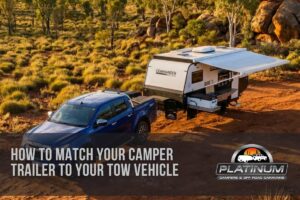
How to Match Your Camper Trailer to Your Tow Vehicle
The wrong camper trailer and tow vehicle combination can result in fines, voided insurance, dangerous instability on the road, and serious mechanical damage. Getting the match right is one of the most important decisions you’ll make before buying a camper trailer. Matching your camper trailer to your tow vehicle comes down to understanding a handful of weight ratings, checking your vehicle’s actual capacities, and choosing a camper that sits comfortably within those limits. This guide breaks down every step of the process so you can tow safely, legally, and confidently across Australia. Key Takeaways Understanding the Weight Ratings That Matter Before comparing camper models or tow vehicles, you need to understand five critical weight figures. These aren’t suggestions. They’re legal limits set by manufacturers and enforced by Australian road authorities. Tare Weight (Tare) is the empty weight of the camper trailer as it leaves the factory, with no gear, water, or cargo loaded. This is your starting point, but never the number you should base your towing decision on. Aggregate Trailer Mass (ATM) is the maximum allowable weight of the trailer when fully loaded, including all cargo, water, fuel, and accessories. According to Platinum Campers’ towing capacity guide, vehicle manufacturers equate towing capacity to ATM, so this is the figure you match against your vehicle’s braked towing capacity. Gross Vehicle Mass (GVM) is the maximum permissible weight of your tow vehicle, including passengers, cargo, fuel, accessories, and towball weight. Roof racks, bull bars, long-range fuel tanks, and recovery gear all count toward this limit. Gross Combination Mass (GCM) is the maximum total weight of your loaded tow vehicle plus the loaded trailer combined. This is the figure that catches most people out. Even if your vehicle’s towing capacity is 3,500kg, the GCM limit may prevent you from actually towing that much once your vehicle is loaded with passengers and gear. Towball Mass (TBM) is the downward force the trailer exerts on your vehicle’s tow hitch. Industry guidelines recommend this sits between 10% and 15% of the trailer’s loaded weight. This weight directly reduces your vehicle’s available payload, which is a detail many buyers overlook. The Two Calculations Every Buyer Must Do Matching a camper to your vehicle requires two simple equations. Getting these right keeps you legal, safe, and insured. Calculation 1: Can your vehicle tow the trailer? Your vehicle’s braked towing capacity must exceed the trailer’s ATM (fully loaded weight). Find your vehicle’s towing capacity in the owner’s manual or on the manufacturer’s website. Never rely on a sales figure you saw online without verifying it against the official specification. For example, a Toyota HiLux 4×4 has a braked towing capacity of 3,500kg. A fully loaded Chariot E1 with an ATM around 1,200-1,500kg sits well within that limit, leaving significant margin for safe towing. Calculation 2: Does the combination stay under GCM? GCM minus your vehicle’s loaded GVM equals the maximum trailer weight you can actually tow. This is where reality diverges from headline towing figures. Take a vehicle with a 6,000kg GCM and a 3,100kg GVM. If your loaded vehicle (with passengers, gear, fuel, and towball weight) weighs 2,800kg, you have 3,200kg remaining for the trailer. That’s under the 3,500kg braked towing capacity, so the GCM becomes the actual limiting factor. According to experienced touring professionals, vehicles with a 3.5-tonne towing capacity can rarely actually tow 3.5 tonnes in real-world conditions once passenger and cargo weight is accounted for. Always calculate with realistic loaded weights. Australian Legal Requirements for Towing Camper Trailers Australian towing laws are consistent on the fundamentals across all states and territories, though some speed limits and licensing rules vary. Braking requirements are tiered by Gross Trailer Mass. Trailers under 750kg GTM don’t legally require their own brakes. Trailers between 750kg and 2,000kg GTM must have electric or override brakes on at least one axle. Trailers over 2,000kg GTM require brakes on all wheels plus a breakaway system that automatically applies the brakes if the trailer detaches. All Platinum Campers hard floor and hybrid models come equipped with electric brakes as standard, meeting these requirements. Towing speed limits vary by state. Most states allow towing at the posted speed limit up to 110km/h, provided the combined vehicle and trailer weight stays under 4,500kg. Western Australia caps towing speed at 100km/h regardless of posted limits. According to the Queensland Government’s towing safety guidelines, drivers are legally responsible for ensuring the towing vehicle, trailer, and tow couplings meet minimum standards and loaded mass limits. Electric brake controllers are required in your tow vehicle when towing a trailer fitted with electric brakes. Most modern 4WDs and utes come with factory-fitted brake controllers, but if yours doesn’t, aftermarket units are straightforward to install. Platinum Campers has a detailed brake controller setup guide to help you get this right. Towing mirrors are legally required when the trailer is wider than the tow vehicle, as specified under Australian Design Rule 14/02. How to Match Platinum Campers Models to Common Tow Vehicles One of the biggest advantages of camper trailers over caravans is their lighter weight and compact towing profile. Most Platinum Campers models fall between 750kg and 1,500kg ATM, which means they’re towable by a much wider range of vehicles than full-size caravans. Here’s a practical matching guide based on vehicle categories: Mid-Size SUVs (1,500-2,000kg Braked Towing Capacity) Vehicles like the Mazda CX-5, Hyundai Tucson, and Subaru Outback fall into this bracket. Their towing capacity suits lighter camper trailers comfortably. Best Platinum Campers matches: The Cadet SE and Chase S5 are ideal choices. Both offer lightweight tare weights that keep the loaded ATM well within mid-size SUV capabilities. The Cadet SE’s soft floor design keeps weight to a minimum, while the Chase S5’s rear fold hard floor provides quick setup without excessive weight penalty. Large SUVs (2,000-3,000kg Braked Towing Capacity) The Isuzu MU-X, Hyundai Palisade, and Toyota Kluger offer solid towing capability with family-friendly cabin space. Best Platinum Campers matches: The full range is available at this capacity level, including