The wrong camper trailer and tow vehicle combination can result in fines, voided insurance, dangerous instability on the road, and serious mechanical damage. Getting the match right is one of the most important decisions you’ll make before buying a camper trailer.
Matching your camper trailer to your tow vehicle comes down to understanding a handful of weight ratings, checking your vehicle’s actual capacities, and choosing a camper that sits comfortably within those limits. This guide breaks down every step of the process so you can tow safely, legally, and confidently across Australia.
Key Takeaways
- Your tow vehicle’s braked towing capacity, GVM, and GCM set the hard limits for which camper trailers you can tow.
- Towball weight (typically 10-15% of loaded trailer weight) directly reduces your vehicle’s available payload capacity.
- Australian law requires trailer brakes on any trailer with a Gross Trailer Mass exceeding 750kg, and breakaway systems above 2,000kg.
- Most Platinum Campers models fall between 750kg and 1,500kg ATM, making them compatible with a wide range of mid-size SUVs, utes, and 4WDs.
- Always calculate with real-world loaded weights, not just the trailer’s tare (empty) weight.
Understanding the Weight Ratings That Matter
Before comparing camper models or tow vehicles, you need to understand five critical weight figures. These aren’t suggestions. They’re legal limits set by manufacturers and enforced by Australian road authorities.
Tare Weight (Tare) is the empty weight of the camper trailer as it leaves the factory, with no gear, water, or cargo loaded. This is your starting point, but never the number you should base your towing decision on.
Aggregate Trailer Mass (ATM) is the maximum allowable weight of the trailer when fully loaded, including all cargo, water, fuel, and accessories. According to Platinum Campers’ towing capacity guide, vehicle manufacturers equate towing capacity to ATM, so this is the figure you match against your vehicle’s braked towing capacity.
Gross Vehicle Mass (GVM) is the maximum permissible weight of your tow vehicle, including passengers, cargo, fuel, accessories, and towball weight. Roof racks, bull bars, long-range fuel tanks, and recovery gear all count toward this limit.
Gross Combination Mass (GCM) is the maximum total weight of your loaded tow vehicle plus the loaded trailer combined. This is the figure that catches most people out. Even if your vehicle’s towing capacity is 3,500kg, the GCM limit may prevent you from actually towing that much once your vehicle is loaded with passengers and gear.
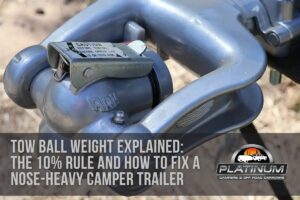
Towball Mass (TBM) is the downward force the trailer exerts on your vehicle’s tow hitch. Industry guidelines recommend this sits between 10% and 15% of the trailer’s loaded weight. This weight directly reduces your vehicle’s available payload, which is a detail many buyers overlook.
The Two Calculations Every Buyer Must Do
Matching a camper to your vehicle requires two simple equations. Getting these right keeps you legal, safe, and insured.
Calculation 1: Can your vehicle tow the trailer?
Your vehicle’s braked towing capacity must exceed the trailer’s ATM (fully loaded weight). Find your vehicle’s towing capacity in the owner’s manual or on the manufacturer’s website. Never rely on a sales figure you saw online without verifying it against the official specification.
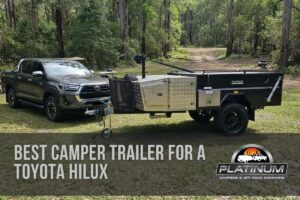
For example, a Toyota HiLux 4×4 has a braked towing capacity of 3,500kg. A fully loaded Chariot E1 with an ATM around 1,200-1,500kg sits well within that limit, leaving significant margin for safe towing.
Calculation 2: Does the combination stay under GCM?
GCM minus your vehicle’s loaded GVM equals the maximum trailer weight you can actually tow. This is where reality diverges from headline towing figures.
Take a vehicle with a 6,000kg GCM and a 3,100kg GVM. If your loaded vehicle (with passengers, gear, fuel, and towball weight) weighs 2,800kg, you have 3,200kg remaining for the trailer. That’s under the 3,500kg braked towing capacity, so the GCM becomes the actual limiting factor.
According to experienced touring professionals, vehicles with a 3.5-tonne towing capacity can rarely actually tow 3.5 tonnes in real-world conditions once passenger and cargo weight is accounted for. Always calculate with realistic loaded weights.
Australian Legal Requirements for Towing Camper Trailers
Australian towing laws are consistent on the fundamentals across all states and territories, though some speed limits and licensing rules vary.
Braking requirements are tiered by Gross Trailer Mass. Trailers under 750kg GTM don’t legally require their own brakes. Trailers between 750kg and 2,000kg GTM must have electric or override brakes on at least one axle. Trailers over 2,000kg GTM require brakes on all wheels plus a breakaway system that automatically applies the brakes if the trailer detaches. All Platinum Campers hard floor and hybrid models come equipped with electric brakes as standard, meeting these requirements.
Towing speed limits vary by state. Most states allow towing at the posted speed limit up to 110km/h, provided the combined vehicle and trailer weight stays under 4,500kg. Western Australia caps towing speed at 100km/h regardless of posted limits. According to the Queensland Government’s towing safety guidelines, drivers are legally responsible for ensuring the towing vehicle, trailer, and tow couplings meet minimum standards and loaded mass limits.
Electric brake controllers are required in your tow vehicle when towing a trailer fitted with electric brakes. Most modern 4WDs and utes come with factory-fitted brake controllers, but if yours doesn’t, aftermarket units are straightforward to install. Platinum Campers has a detailed brake controller setup guide to help you get this right.
Towing mirrors are legally required when the trailer is wider than the tow vehicle, as specified under Australian Design Rule 14/02.
How to Match Platinum Campers Models to Common Tow Vehicles
One of the biggest advantages of camper trailers over caravans is their lighter weight and compact towing profile. Most Platinum Campers models fall between 750kg and 1,500kg ATM, which means they’re towable by a much wider range of vehicles than full-size caravans.
Here’s a practical matching guide based on vehicle categories:
Mid-Size SUVs (1,500-2,000kg Braked Towing Capacity)
Vehicles like the Mazda CX-5, Hyundai Tucson, and Subaru Outback fall into this bracket. Their towing capacity suits lighter camper trailers comfortably.
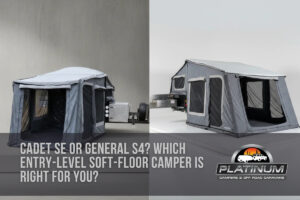
Best Platinum Campers matches: The Cadet SE and Chase S5 are ideal choices. Both offer lightweight tare weights that keep the loaded ATM well within mid-size SUV capabilities. The Cadet SE’s soft floor design keeps weight to a minimum, while the Chase S5’s rear fold hard floor provides quick setup without excessive weight penalty.
Large SUVs (2,000-3,000kg Braked Towing Capacity)
The Isuzu MU-X, Hyundai Palisade, and Toyota Kluger offer solid towing capability with family-friendly cabin space.
Best Platinum Campers matches: The full range is available at this capacity level, including the General S4, Warrior S4, Quest E1, and Discovery E1. These vehicles handle the full complement of camping gear, water, and accessories without approaching their limits.
4WD Wagons and Dual-Cab Utes (3,000-3,500kg Braked Towing Capacity)
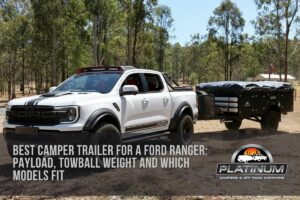
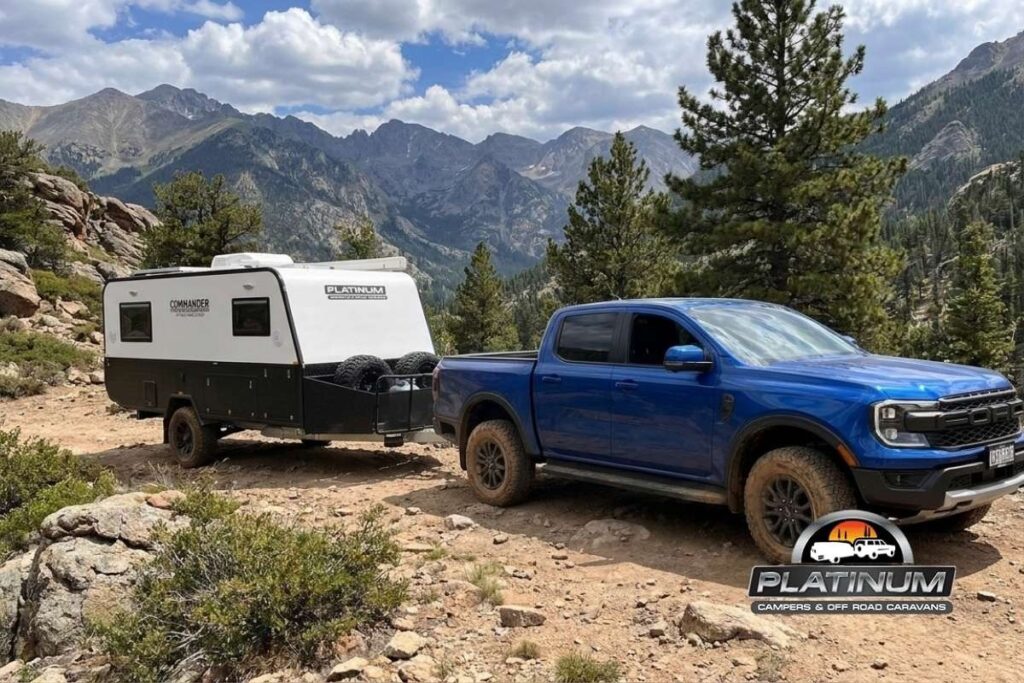
The Toyota LandCruiser, Ford Ranger, Isuzu D-MAX, and Ford Everest represent the top tier for camper trailer towing. With 3,500kg braked capacity, these vehicles tow any Platinum Campers model with significant margin.
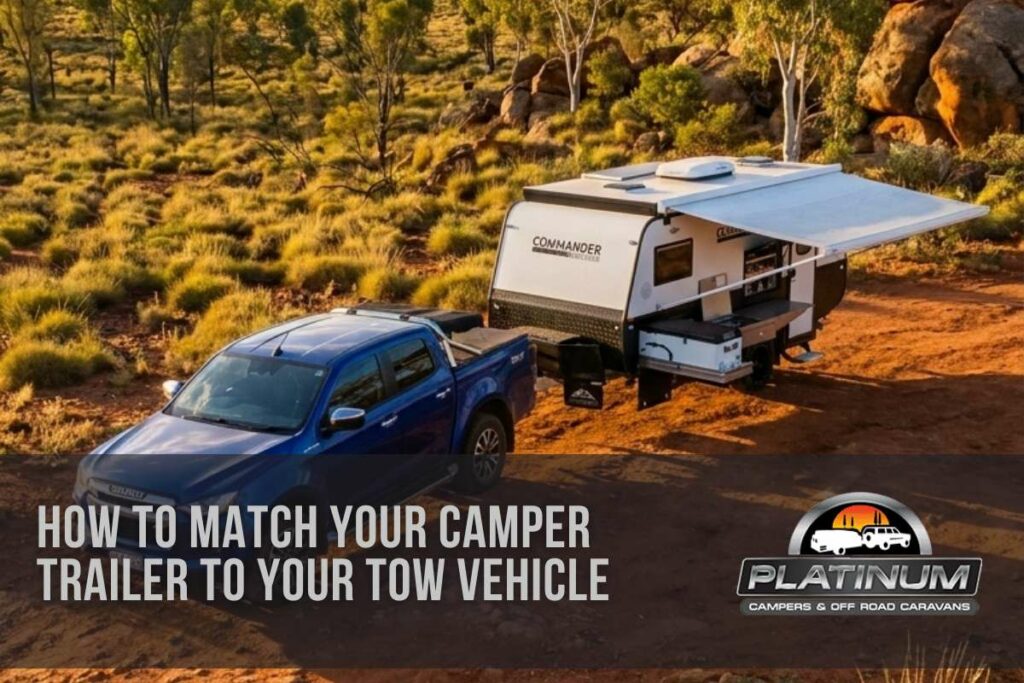
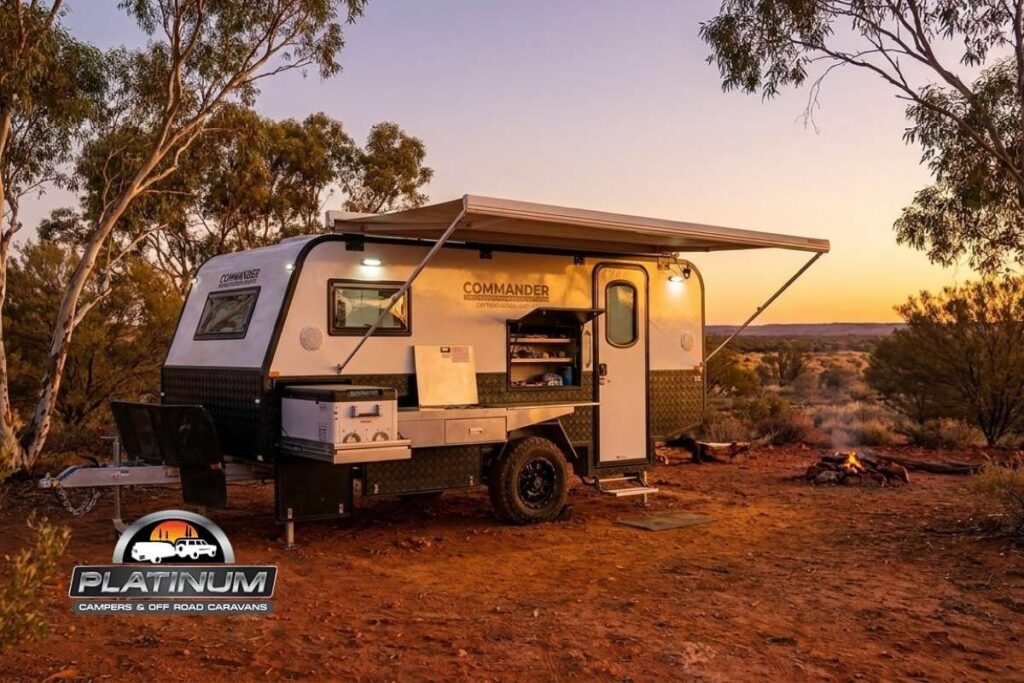
Best Platinum Campers matches: Every model in the range, including the Chariot E1 and Commander Hybrid. These vehicles have the power, suspension, and braking capacity to handle fully loaded campers on extended off-road touring. If you’re planning serious outback travel, this is the category to be in.
Matching Guide: Platinum Campers by Tow Vehicle Category
| Platinum Campers Model | Type | Ideal Tow Vehicle Category | Minimum Recommended Towing Capacity |
| Cadet SE | Soft Floor | Mid-size SUV and above | 1,500kg+ |
| General S4 | Soft Floor (Step Through) | Large SUV and above | 2,000kg+ |
| Warrior S4 | Soft Floor (Step Through) | Large SUV / 4WD | 2,000kg+ |
| Chase S5 | Hard Floor (Rear Fold) | Mid-size SUV and above | 1,800kg+ |
| Quest E1 | Hard Floor (Rear Fold) | Large SUV and above | 2,000kg+ |
| Discovery E1 | Hard Floor (Forward Fold) | Large SUV / 4WD | 2,000kg+ |
| Chariot E1 | Hard Floor (Double Fold) | Large SUV / 4WD | 2,500kg+ |
| Commander Hybrid | Hybrid | 4WD / Dual-Cab Ute | 2,500kg+ |
Note: Always verify your specific vehicle’s towing capacity, GVM, GCM, and towball rating against the camper’s actual loaded weight before purchasing.
Beyond Towing Capacity: Other Factors That Affect the Match
Raw towing numbers don’t tell the whole story. Several real-world factors determine how well your vehicle and camper work together on the road.
Engine Type and Power Delivery
Diesel engines generally make superior tow vehicles compared to petrol equivalents. Diesel powertrains produce higher torque at lower RPM, which translates to better pulling power on hills, more relaxed highway cruising, and lower fuel consumption under load. If you’re choosing a tow vehicle specifically for camper trailer touring, diesel is the stronger option in most cases.
Suspension and Ride Quality
Your vehicle’s suspension affects both towing stability and ride comfort. Vehicles with heavy-duty or adjustable suspension cope better with the constant towball weight pressing down on the rear axle. Aftermarket suspension upgrades (heavy-duty springs, airbag assists) can transform a vehicle’s towing composure, particularly for extended touring where the tow vehicle is also heavily loaded with gear.
Wheelbase and Weight Distribution
Longer wheelbase vehicles tow more stably than shorter ones. The greater distance between the front and rear axles provides better leverage against the trailer’s lateral forces, reducing sway. This is why dual-cab utes and full-size 4WD wagons feel more planted when towing than compact SUVs, even at similar towing capacities.
Cooling Systems
Towing generates significantly more heat in the engine, transmission, and brakes. Vehicles with factory towing packages typically include upgraded cooling systems (larger radiators, transmission oil coolers) designed to handle sustained loads. If your vehicle doesn’t have a factory towing package, consider aftermarket cooling upgrades before extended touring, particularly in hot Australian conditions.
Fuel Tank Range
Towing increases fuel consumption by roughly 20-40% depending on terrain, speed, and trailer weight. A vehicle with a 60-litre tank that normally offers 800km range might only manage 500-600km while towing. For remote outback touring, vehicles with larger tanks (80L+) or long-range aftermarket tanks provide critical peace of mind between fuel stops.
Common Mistakes When Matching Camper Trailers to Tow Vehicles
Relying on towing capacity alone. The headline towing figure is only one of several limits. GCM, GVM, towball weight, and axle ratings all apply simultaneously. The lowest of these limits sets your actual towing ceiling.
Ignoring payload when calculating towball weight. Towball weight counts as payload on your vehicle. If your GVM payload capacity is 600kg and your towball weight is 150kg, you only have 450kg left for passengers, fuel, and cargo in the vehicle. A family of four with gear can easily exceed this.
Using tare weight instead of ATM. A camper trailer’s tare weight is its empty factory weight. By the time you add water (100kg for a 100L tank), a fridge, recovery gear, food, clothing, and accessories, the loaded weight can be 200-400kg heavier than tare. Always match against realistic loaded weight.
Buying the camper first, then trying to match a vehicle. Ideally, know your vehicle’s actual capacities before shopping for a camper. If you already own the vehicle, bring your owner’s manual to the showroom so the team can help you find the right match.
Not weighing your setup. The only way to confirm you’re legal is to weigh your loaded vehicle and trailer at a public weighbridge. Estimates and guesswork leave you exposed to fines, insurance issues, and safety risks.
Frequently Asked Questions
What towing capacity do I need for a camper trailer?
Most camper trailers require a braked towing capacity between 1,500kg and 3,000kg depending on the model and how heavily you load them. Lightweight soft floor models like the Cadet SE work well with vehicles rated at 1,500kg+, while larger hard floor and hybrid models need 2,500kg or more.
Can I tow a camper trailer with an SUV?
Yes. Many mid-size and large SUVs have sufficient towing capacity for camper trailers. The key is matching the specific SUV’s braked towing capacity, GVM, and GCM against the loaded weight of the camper you’re considering. Lightweight camper trailer options make SUV towing even more accessible.
What is the 80% towing rule?
Industry professionals widely recommend keeping your loaded trailer weight at or below 80% of your vehicle’s maximum braked towing capacity. This provides a safety margin for hill climbing, overtaking, emergency braking, and unexpected weight additions. It also reduces mechanical stress on your vehicle.
Do I need a brake controller for a camper trailer?
Yes, if the camper has electric brakes, which all trailers over 750kg GTM are legally required to have in Australia. Many modern 4WDs and utes include factory-fitted brake controllers. If yours doesn’t, refer to Platinum Campers’ brake controller guide for installation advice.
What’s the difference between ATM and GTM?
ATM (Aggregate Trailer Mass) is the maximum loaded weight of the trailer when disconnected from the tow vehicle and resting on its jockey wheel. GTM (Gross Trailer Mass) is the maximum weight on the trailer’s axle(s) when connected to the tow vehicle. ATM is always slightly higher than GTM because some weight transfers to the vehicle via the towball.
How does towball weight affect my vehicle?
Towball weight presses down on your vehicle’s rear axle and counts directly against your vehicle’s GVM payload capacity. Excessive towball weight overloads the rear suspension, lifts the front wheels, reduces steering response, and can make the vehicle unsafe. Too little towball weight causes trailer sway. The 10-15% range provides optimal stability.
Can I increase my vehicle’s towing capacity?
It is technically possible through component upgrades (suspension, brakes, cooling) followed by engineering recertification, but the process must comply with Australian Design Rules and be approved by an authorised engineer. It’s generally more practical to choose a camper that fits within your vehicle’s existing capacity.
What’s the best tow vehicle for off-road camper trailers?
For serious off-road touring, dual-cab utes and 4WD wagons with 3,000kg+ towing capacity, low-range transfer cases, and diesel engines offer the best combination of power, clearance, and capability. The Toyota LandCruiser, Ford Ranger, and Isuzu D-MAX are popular choices among Australian camper trailer owners.
How much extra fuel will I use towing a camper trailer?
Fuel consumption typically increases 20-40% when towing a camper trailer, depending on the trailer’s size, weight, aerodynamic profile, terrain, and driving speed. Camper trailers generally have a lower fuel penalty than caravans due to their more compact, lower-profile towing shape. Understanding the total cost of camper ownership helps you budget accurately.
Should I buy the camper or the tow vehicle first?
Ideally, decide on the type of camping you want to do first, then select the camper that suits those needs, and finally confirm your current or intended tow vehicle can handle it. If you already own a vehicle, start by documenting its towing capacity, GVM, GCM, and towball rating, then bring those figures to a Platinum Campers showroom for expert matching advice.
Get Your Match Right the First Time
Choosing the right camper trailer and tow vehicle combination sets the foundation for every trip you’ll take. Platinum Campers’ range is designed to suit everything from mid-size SUVs to heavy-duty 4WDs, with models spanning soft floor, hard floor, and hybrid configurations. Every model is Australian designed and built with off-road capability, so you’re investing in a camper that performs when it counts.
Explore the full Platinum Campers range or contact our team to match the perfect camper to your tow vehicle.
Sources
- Queensland Government — Towing Vehicles and Trailers: https://www.qld.gov.au/transport/vehicle-safety/towing/towing-vehicles-and-trailers
- South Australian Government — Light Vehicle Towing Regulations: https://www.sa.gov.au/topics/driving-and-transport/vehicles/vehicle-standards-and-modifications/loads-and-towing/light-vehicle-towing-regulations
- NRMA — How to Choose a Tow Vehicle: https://www.mynrma.com.au/open-road/advice-and-how-to/buying-or-selling-a-car/how-to-choose-a-great-tow-vehicle
- Platinum Campers — Camper Trailer Weights and Towing Capacity Jargon Explained:https://www.platinumcampers.com.au/camper-trailer-weights-towing-capacity-jargon/