Platinum Campers

Camper Trailers for Sale

Finding the Perfect Match for Your Adventures

Finding the Perfect Match for Your Adventures

The allure of the great outdoors, the call of the wild Australian landscape, and the passion for camping are driving many towards investing in camper trailers. However, with the sheer volume of options available, choosing the right trailer can seem overwhelming. In this guide, we’re here to help streamline your decision-making process.

Camper Trailer at lake

How Much Is a Good Trailer?

Cost is often the first factor many consider. A quality camper trailer can range anywhere from a few thousand to over fifty thousand dollars. Factors that influence this price range include the trailer’s size, build quality, features, brand reputation, and customisation options. At Platinum Campers, we’ve positioned ourselves to offer the best of both worlds – top-tier trailers that are both quality-built and affordable.

How Do I Choose a Camper Trailer?

  1. Understanding Your Needs:

    When considering a camper trailer, it’s paramount to evaluate who will be using the trailer and under what conditions. Answer a few pivotal questions for yourself:

    • How many people do I usually travel with, and will I occasionally need extra space for additional guests or family?
    • What’s the towing capacity of my vehicle, ensuring I don’t select a trailer that’s too heavy?
    • Which features and options are non-negotiable for my camping experience, and which ones can I compromise on?

    For instance, if your travels are typically more intimate, such as romantic getaways or solo adventures, the Chase S5 – Rear fold Hard Floor Camper is a perfect fit. Conversely, larger groups or families might find the Cadet SE – Soft Floor Camper more suitable with its increased space.

  2. Considering Weight & Towing Capacity: A common oversight is neglecting to consider the towing vehicle’s capability. For an in-depth look at this, check out our guide on trailer weight and towing jargon.

  3. Checking Inclusions: When searching for camper trailers, it’s essential to look at what’s included as standard. It’s always a bonus when trailers offer comprehensive standard inclusions or provide the ability to upgrade. It’s worth noting, however, that some competitors may overload their campers with accessories that not every camper might need or want. For instance, having an Inverter, Lithium Batteries, and Air-Cons can drive the starting price up significantly. But what if you don’t desire all those extras? At Platinum Campers, we pride ourselves on our flexibility. You have the liberty to customise, allowing you to add what you need and leave out what you don’t. This ensures you’re not paying for features that don’t align with your camping vision.

  4. Consult Expert Sources and Personalise Your Decision:

    Navigating the vast world of camper trailers can be daunting. To ease this process, our Camper Trailer Buyers Guide is available to provide clarity and valuable insights. But sometimes, a personal touch can make all the difference. If you’re still unsure or have specific queries, don’t hesitate to call or email us. Our experienced team is more than happy to guide you, ensuring you find the perfect camper based on your needs and towing restrictions. We’re here not just to sell, but to ensure your adventures are precisely as you envision.

How Long Does a Camper Trailer Last?

A quality-built camper trailer can serve you well for 10 to 20 years with proper care. Factors like construction quality play a pivotal role. Learn more about where Platinum Campers are made.

How Much Should I Spend on a Camper Trailer?

This varies. Consider your camping frequency, essential features, number of campers, and potential resale value.

Is It Hard Living in a Camper Trailer?

Adopting a nomadic lifestyle in a camper trailer can be both challenging and rewarding. The initial phase might require adjustments due to limited space. However, the freedom of choosing your view and closeness to nature can be fulfilling.

Is 1500kg or 2500kg Better for a Camper Trailer?

Both weights have their advantages. A 1500kg trailer is easier to tow and more fuel-efficient. A 2500kg trailer offers more amenities and space but requires a powerful towing vehicle. Always refer to our trailer weight guide.

What is the Difference Between a Camper Trailer and a Travel Trailer?

While the terms are often used interchangeably, there are distinctions. A camper trailer is a term more commonly used in Australia and typically denotes a more rugged, off-road vehicle ideal for the Australian outback. They are designed for camping and often come with basic amenities.

On the other hand, a travel trailer, more common in North American terminology, is often larger, equipped with many of the amenities of home and is designed for long-term living or traveling. They might not always be suited for rough terrains like camper trailers.

Choosing between the two comes down to your intended use, travel locations, and personal preferences.

Final Thoughts...

Choosing the perfect camper trailer is about more than just the specs and features; it’s about elevating your entire camping adventure. As the vast and diverse landscapes of Australia beckon, ensure you’re equipped with the ultimate travel companion. After all, the joy of camping isn’t just in reaching your destination, but in the journey you take to get there. Happy camping!

Eager to embark on your next great outdoors adventure? Reach out to us today, and together, we’ll set the course for your unforgettable expedition. Your next chapter in the great Australian outdoors begins with us!

Get in Touch

Tow Ball Weight Explained Featured image
Uncategorized
nico

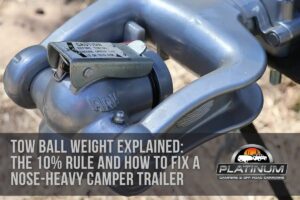
Tow Ball Weight Explained: The 10% Rule and How to Fix a Nose-Heavy Camper Trailer

Tow ball weight is the downward force your camper trailer places on the vehicle’s tow ball when hitched. Get it wrong and you risk poor handling, reduced braking, illegal overloading of your vehicle’s payload, or a dangerous sway. Get it right and your rig tracks straight, stays within legal limits and tows predictably on Australian roads and tracks. This guide explains tow ball weight (also called tow ball mass or towball download), the widely used 10% rule, how to measure it with tow ball weight scales, and practical ways to fix a nose-heavy camper trailer. Overview You will learn what tow ball weight is, how it links to ATM, GTM, GVM and payload, why the 10% guideline exists, how to weigh ball mass accurately, how packing shifts the balance, and how to correct a nose-heavy setup. You will also see how Platinum Campers models and load planning fit into safe matching of trailer and tow vehicle. Key Takeaways What Is Tow Ball Weight (and Towball Download)? Tow ball weight is the static downward load transferred through the coupling onto the tow ball or hitch receiver when the trailer is coupled and sitting level. In Australian towing language you will also hear tow ball mass (TBM) and towball download. They describe the same vertical force, not the trailer’s total mass. When the trailer is uncoupled, that same mass sits on the jockey wheel. When coupled, it becomes part of the tow vehicle’s rear load. It must be subtracted from the weight you can still carry as people, luggage and accessories in the car. These related weight terms all affect each other: Term Meaning Why it matters for ball weight Tare Trailer weight as delivered, empty of payload and usually without fluids Baseline before you pack ATM Max allowed trailer mass uncoupled (including everything on the trailer) 10% rule is often applied to loaded ATM GTM Max trailer mass on its axles when coupled Ball weight is not all on the trailer axles when hitched TBM / tow ball weight Downward load on the tow ball Eats vehicle payload; must not exceed ratings GVM Max allowed mass of the loaded tow vehicle TBM counts inside GVM Payload GVM minus kerb (and other deductions as specified) Passengers + cargo + TBM must fit GCM Max combined vehicle + trailer mass Caps the whole rig For plain definitions of ATM, GTM, GVM and payload, read our camper trailer weights and towing capacity guide before you finalise a purchase. Towball download is simply another name for that downward ball load. If someone asks for “download,” they want the kilogram figure on the ball, not a software file. Why Tow Ball Weight Matters on Australian Roads Correct tow ball weight keeps the hitch planted so the trailer follows rather than steers the car. Too little ball weight (tail heavy) lets the trailer yaw and amplify sway from wind, trucks or corrugations. Too much (nose heavy) squats the rear, lightens the front axle, dulls steering, lengthens stopping distances and can overload the towbar, coupling or rear tyres. Legally and practically you must not exceed: State road rules still require a safe, compliant combination. Manufacturer ratings on the vehicle plate and trailer compliance plate are the hard limits. Industry rules of thumb never override those numbers. Off-road and beach runs add pitch and bounce, so a ball mass that felt fine on the highway can spike on corrugations. That is another reason to measure loaded ball weight as you will actually travel, then leave margin. For soft surfaces, pair balance with sensible beach towing technique and tyre pressures. The 10% Rule for Tow Ball Weight The 10% rule means many light trailers tow most stably when tow ball weight is about 10% of the trailer’s actual loaded ATM, within the limits on both vehicle and trailer. Example method (illustrative only): if your loaded trailer mass is 1,400 kg and sits under ATM, a starting target is around 140 kg on the ball, then verify against the car’s maximum TBM and your remaining payload. How to apply the 10% rule safely Tow ball weight is commonly around 10% of the loaded trailer weight, though it varies with trailer length, suspension and coupling type; check your vehicle and trailer manuals. Caravans and long hybrids can behave differently from compact camper trailers. Always prefer the trailer and vehicle makers’ stated ball mass guidance when they publish it. If 10% of ATM is higher than your vehicle’s rated tow ball download, you cannot “take the 10%.” You must reduce trailer mass, change load distribution only within safe design, or choose a lighter trailer and match your camper trailer to your tow vehicle. Nose-Heavy vs Tail-Heavy: What You Are Fixing Nose-heavy camper trailer (ball weight too high) Symptoms Main risks Tail-heavy camper trailer (ball weight too low) Symptoms Main risks A stable camper sits level, within ratings, with ball weight in the sensible band. Level stance alone is not enough if the kilogram figure is wrong. How to Measure Tow Ball Weight with Scales Guessing by bumper height is unreliable. Tow ball weight scales (dedicated ball weight scales or a suitable load scale under the jockey wheel/coupling) give a repeatable number. Method A: Dedicated tow ball weight scale Method B: Jockey wheel / pad scale Method C: Public weighbridge (whole-rig check) Measurement tips that prevent bad data Write the number on a card in the glovebox: target band, absolute maximum TBM for your vehicle, and last measured value. Recheck when your packing style changes. How Packing and Design Change Tow Ball Weight Ball weight is not fixed at the factory once you add payload. Every kilogram you place ahead of the axle cluster increases towball download; every kilogram behind decreases it. Water tanks, jerry cans, kitchens, fridges and recovery gear are the big movers. High-impact load items Camper layout patterns Empty ball mass on the compliance discussion is only a start. Your real tow ball weight is the packed number. How to
Read More »
Platinum Camper Trailer for Toyota Hilux
Buying Support
nico

Best Platinum Camper Trailer for a Toyota HiLux

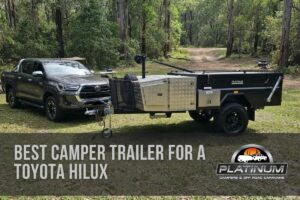
The best camper trailer for a Toyota HiLux is a braked off-road camper with a loaded ATM between 1,500kg and 2,000kg, because that range fits comfortably inside the payload most dual cabs have left after accessories and passengers. The Platinum Chase S5 (900kg tare, 1,500kg ATM), Cadet SE (1,000kg tare, 1,700kg ATM) and General S4 (1,100kg tare, 2,000kg ATM) cover the majority of HiLux setups. Your ute’s 3,500kg braked tow rating is almost never the number that stops you. Payload is. Key Takeaways Overview This guide starts with the weight maths, because every other decision follows from it. You will work out what your HiLux can genuinely carry, then match that number to a Platinum model, a floor type and a towing setup. The last sections cover beach and outback towing, a buying checklist, finance and warranty, and ten common questions. Start With Payload, Not Tow Rating Your HiLux has one payload allowance and four things compete for it: accessories, passengers, cabin gear and tow ball mass. The tow rating sits in a separate column and rarely runs out first. Payload is your GVM (the maximum legal loaded weight of the ute) minus what the ute actually weighs. On a 2026 SR5 dual cab 4×4 auto, that is a 3,120kg GVM less a 2,020kg kerb weight, which leaves 1,100kg. GVM across the 2026 range runs from 3,065kg to 3,120kg, with kerb weights between 1,830kg and 2,327kg. A 500kg spread in kerb weight is why two HiLux utes in the same car park can have very different answers. Now watch that 1,100kg disappear: Item Weight Payload left Starting payload, SR5 dual cab 4×4 auto 1,100kg Steel canopy, drawer system, bull bar, second battery 250kg 850kg Two adults, two children 260kg 590kg Fridge, recovery gear, cabin luggage 100kg 490kg Tow ball mass, Chariot-size camper 130kg 360kg The accessory, passenger and gear figures above are realistic estimates for a touring build. The tow ball figure comes from Platinum’s own weights and towing jargon guide, which uses roughly 130kg for a Chariot. This example stays legal with 360kg spare. Add a heavier canopy, a third adult or a full 100L water tank on departure and that margin closes fast. The Weight Terms You Need Term What it means Where to find it Tare Empty camper weight as delivered Camper compliance plate ATM Maximum loaded camper weight, unhitched Camper compliance plate GTM Maximum weight on the camper’s axles when hitched Camper compliance plate Tow ball mass Downward load the camper puts on your towbar Camper specs, confirmed on scales GVM Maximum legal loaded weight of the HiLux Vehicle compliance plate GCM Maximum combined weight of ute plus camper Owner’s manual Payload GVM minus the ute’s actual weight Weighbridge The gap between tare and ATM is your camper’s own payload. The Cadet SE leaves around 700kg for gear and water, while the General S4 leaves roughly 900kg. Where the 2026 HiLux Improved Toyota put the ninth-generation HiLux on sale in Australia on 9 December 2025, and the 4×4’s gross combination mass rose from 5,850kg to 6,300kg. That extra 450kg is real headroom for a loaded ute pulling a loaded camper. Toyota also addressed payload directly. A factory-fitted GVM upgrade option launched on select 4×4 grades in August 2026, priced from $4,000, adding 372kg to 435kg of payload depending on variant and allowing a maximum payload of roughly 1,525kg. Toyota recommends that upgraded vehicles run with a permanent minimum payload, since operating them lightly loaded can noticeably reduce ride comfort. A GVM upgrade does not lift GCM, axle ratings or towbar limits, so check all four before you size up. Run these five steps before you shortlist anything: Platinum Campers Models That Suit a HiLux Three models cover most HiLux buyers. Three more suit owners with payload to spare. Model Type Tare ATM Sleeps Best for Chase S5 Hard floor rear fold 900kg 1,500kg 2 adults, 2 kids Heavily accessorised dual cabs Cadet SE Soft floor 1,000kg 1,700kg 2 adults, 4 kids Value-focused families General S4 Soft floor step-through 1,100kg 2,000kg 4 adults, 4 kids Bigger families, more storage Warrior S4 Soft floor step-through 1,390kg 2000kg 4 Adults, 4 Children Remote and rough access Quest Hard floor rear fold 1,100kg 2,000kg 2 adults, 2 kids Hard floor with more storage Chariot E1 Hard floor double fold 1,300kg 2000kg Up to 6 adults Families with payload headroom Discovery E1 Hard floor forward fold 1,350kg 2000kg 2 Adults & 2 Children Longer stays in one site Commander Hybrid 2,100kg 2,900kg 2 Adults, 2 Children Extended off-grid touring Chase S5: the widest safety margin If your HiLux already carries a canopy, drawers and a fridge, start here. The Chase S5 has a tare weight of just 900kg, which means it can be towed by most standard SUVs or 4WDs. Setup is quick: unclip four latches, wind the floor down on the included winch, add six tent poles, and the queen bed is already made. Standard equipment includes an integrated kitchenette with sink, two drawers and a two-burner gas BBQ, plus a fully enclosed annex with walls. The chassis uses 3mm RHS construction with a 100x50x4mm drawbar, and it carries a 100L stainless steel water tank with an external tap. Suspension is a solid axle setup rather than independent. It runs 7-leaf eye-to-eye springs with a heavy-duty 50mm solid axle, off-road tyres and a fully galvanised, hammertone powder-coated chassis, designed for dirt roads, beaches and basic off-roading. That suits weekend touring more than sustained corrugations. Cadet SE and General S4: soft floor space for families These two share a platform and differ mainly in access and capacity. The Cadet SE uses a ladder to reach its queen bed and sleeps two adults plus four children. The General S4 uses internal step-through stairs, sleeps four adults plus four children, and adds storage, power outlets and payload for about $2,000 more. Both are built for full off-road use on the same platform, with dual-shock independent suspension, heavy-duty coil springs, a fully galvanised

Read More »
Bringing your camper out of storage
Maintenance & Care
nico

Bringing Your Camper Out of Storage: The 12-Point Restart Check

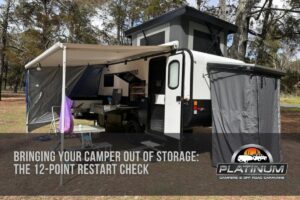
To bring your camper out of storage safely, complete a full restart inspection before you hitch up: check structure, tyres, brakes, hitch, lights, battery, water, gas, canvas, interior systems, undercarriage, then do a short road test. Skipping this step is one of the fastest ways to turn the first trip of the season into a breakdown or a failed safety check. Australian conditions are hard on stored gear. Heat, humidity, dust, rodents, UV and long periods of sitting still all take a toll on seals, canvas, electrics and wheel ends. Whether your unit is a soft floor, rear fold, forward fold, double fold or hybrid, a structured bringing your camper out of storage checklist gets you road-ready faster and with fewer surprises. This guide walks you through a practical 12-point restart process designed for Aussie camper trailers, with clear actions you can complete at home or at a storage yard before your first weekend away. Overview You will learn how to de-winterise or de-storage your camper trailer in a logical order, what to inspect on each system, when to stop and book a service, and how to pair this deep restart with a faster pre-trip routine. You will also find a scannable checklist table, packing and load tips, and FAQs that answer the most common restart questions. Key Takeaways Why a Restart Check Matters After Storage Storage protects your investment, but it does not pause wear. Rubber dries, grease settles, moisture finds seams, and small pests look for soft materials and wiring looms. A camper that looked perfect when you parked it can hide soft tyres, seized brakes, a depleted battery or a canvas leak by the time you return. A restart check is deeper than a roadside once-over. It is the bridge between long-term camper storage and trip-ready condition. Do it once at the start of the season (or after any long lay-up), then rely on a shorter routine such as a 10-minute pre-trip inspection before each departure. If you are still refining how and where you store the trailer between trips, practical layout ideas in creative camper trailer storage ideas can reduce damage risk before the next lay-up. Bringing Your Camper Out of Storage Checklist: The 12-Point Restart Work through the points in order. Fix or flag issues as you go. If a safety item fails (tyres, brakes, hitch, lights, gas), do not tow until it is rectified. 1. Full Exterior and Structural Walkaround Start unhitched, on level ground, with the handbrake on and wheels chocked if needed. Inspect the chassis rails, A-frame, drawbar, body panels, stone guard, toolboxes and fixings for rust, cracks, loose bolts, impact damage or elongated holes. Check door and hatch seals for compression set, mould or gaps. Look under edges and in corners for mud-wasp nests, rodent entry and chewed wiring. Confirm jockey wheel operation, clamp tightness and foot condition. Extend and retract stabiliser legs and confirm they lock cleanly. Sticky or bent legs are easier to deal with at home than on soft ground at camp. For ongoing care, see tips for using and maintaining stabiliser legs. Action list: 2. Tyres, Wheels and Torque Tyres are the highest-frequency failure point after storage. Sidewalls can crack, pressures drop, and flat spots can appear after months in one position. Check age and condition of all tyres including the spare. Look for cracking, bulges, uneven wear, embedded objects and damaged valves. Set pressures to the camper manufacturer’s cold recommendation for your load, then recheck after a short tow. Confirm wheel nuts are present and torqued to the correct specification, then re-torque after the first 50–100 km of the season if your service advice requires it. If the trailer sat on soft ground or soft tyres, inspect rims for corrosion at the bead. Spin each wheel (safely raised and supported) and listen for roughness that may point to bearing issues. Action list: 3. Brakes, Bearings and Handbrake Wheel ends suffer when a camper sits. Grease can settle, moisture can ingress and brake shoes can corrode to drums. With the trailer safely supported, check bearing play and noise. Service intervals vary by use and water crossings, so if you are due, book a bearing repack before the first big trip rather than after a roadside failure. Confirm electric brake function with a compatible controller, and test the breakaway system according to the unit’s design. Operate the handbrake and look for cable fray, seizure or excessive travel. Binding brakes after storage are common; a short controlled test in a quiet area helps you feel drag or pull early. For broader service timing guidance, read how often you should service an off-road camper trailer and general maintenance tips. 4. Hitch, Coupling, Chains and Safety Gear Your coupling is the connection that keeps the combination together. Inspect the hitch head, poly block or equivalent coupling, locking pins, lynch pins, safety chains, shackles and rated attachments on the A-frame. Confirm the tow vehicle receiver, tongue weight hardware and electrical socket are clean and serviceable. Practise the hook-up sequence before departure day so you are not learning under time pressure. Platinum owners can revisit how to use Platinum Campers hitches and essential hitch safety checks. Action list: 5. Lights, Plugs and Trailer Electrics Plug in the trailer connector and test indicators, brake lights, tail lights, number plate light and any clearance lamps. Wiggle the plug gently while testing to expose intermittent faults. Inspect the loom along the drawbar for chafing, poorly supported cable and corrosion in connectors. Clean contacts and apply an appropriate electrical protectant if needed. Confirm the Anderson plug path (if fitted) is clean and secure for charging on the move. A dedicated guide on Anderson plugs and 12V setups helps you verify charging behaviour after storage. 6. Battery, Charging and 12V Loads A stored camper often returns with a flat or sulphated battery, especially if it sat without a maintainer. Start here before you assume a fridge, pump or light has failed. Measure resting voltage, inspect terminals for

Read More »
Best Platinum Camper Trailers for Ford Ranger
Buying Support
nico

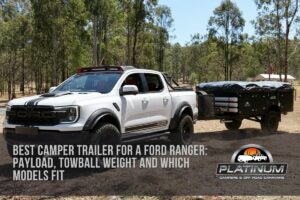
Best Camper Trailer for a Ford Ranger: Payload, Towball Weight and Which Models Fit

The best camper trailer for a Ford Ranger is the one that stays inside your Ranger’s braked towing capacity, gross combination mass (GCM), payload and tow ball mass limits once you add people, fuel, gear and water. For most Australian dual-cab Rangers, that usually means a compact to mid-size soft-floor or hard-floor camper with a sensible tare weight and controlled tow ball mass, not the heaviest hybrid you can hitch. Platinum Campers designs Australian camper trailers for real off-road use, quick setup and strong value, which makes several models a practical match for Ranger owners who want comfort without overloading the ute. This guide explains the weight rules that matter, how to check your specific Ranger, and which Platinum layouts suit couples, families and serious tracks. Overview You will learn how Ford Ranger towing really works in Australia, why payload and tow ball weight matter more than a single “tows 3.5 tonne” headline, and how to shortlist a camper trailer that fits your vehicle and trips. We cover soft-floor and hard-floor options, a model-fit comparison, packing tips, finance, warranties and FAQs so you can buy with confidence. Key Takeaways Why a Camper Trailer for a Ford Ranger Works So Well in Australia The Ford Ranger is one of Australia’s most popular tow vehicles because dual-cab 4×4 variants combine daily usability with serious braked towing ability. A well-matched camper trailer turns that ute into a weekend escape rig or a long-haul touring setup without the bulk of a large caravan. Rangers handle coastal runs, forest tracks and outback corrugations when the trailer is correctly specified. Independent suspension, a strong chassis and sensible ATM on the camper side keep the combination stable and legal. The catch is simple: many owners buy on towing capacity alone, then discover payload disappears under passengers, canopies, drawers, recovery gear and tow ball load. Choosing a camper trailer for a Ford Ranger is a weight-management decision as much as a lifestyle one. For a plain-English refresher on ATM, GTM, GVM and GCM, read Platinum Campers’ guide to camper trailer weights and towing capacity jargon. That foundation stops expensive mismatches before they start. Ford Ranger Towing Limits: What You Must Check First Start with your exact Ranger badge, year, cab style, drivetrain and any GVM upgrade. Factory ratings differ across XL, XLS, XLT, Sport, Wildtrak and other variants, and accessories change real-world payload. Critical numbers on the ute Your legal combination must respect every limit at once. If GCM is the lowest ceiling after you load the ute, your usable trailer mass may be well below the advertised towing figure. Critical numbers on the camper Platinum’s weight explainer walks through how GCM, GVM and GTM interact with family loads. Use it beside your Ranger handbook before you compare models on the Platinum Campers range. Action steps Payload and Tow Ball Weight: The Real Gatekeepers Payload and tow ball weight decide whether a camper trailer for a Ford Ranger feels safe and stays legal. Tow ball mass is not “free.” When the camper is hitched, TBM is carried by the rear of the Ranger and consumes payload that you might have reserved for kids, fridges, tools or a canopy. A family of four plus a steel canopy and drawer system can erase hundreds of kilograms before the trailer is even connected. How tow ball mass gets out of hand How to keep TBM under control If you want a compact, efficient starting point, explore small camper trailers built for easier towing and simpler storage at home. Which Platinum Campers Models Suit a Ford Ranger? There is no single “only” answer, because Rangers and trip styles differ. As a rule, lighter soft-floor and compact hard-floor campers are the easiest fit for dual-cab Rangers used by couples and families. Larger double-fold or hybrid setups need stricter weight discipline and a high-spec tow vehicle with residual payload. Below is a practical fit guide based on use case. Always verify current tare, ATM and ball mass with Platinum Campers for the exact build you order. Comparison table: Ranger use case vs Platinum direction Your Ranger use case Priority limits Strong Platinum direction Why it fits Couples, weekends, lighter SUV/ute loads Low tare, quick setup, modest TBM Chase S5 (rear fold hard floor), Cadet SE (soft floor) Compact towing footprint and efficient camp setup First family camper, value focus Balance of space and weight General S4 step-through soft floor Accessibility, storage and family-friendly layout Rough tracks, serious off-road Chassis strength, ground clearance mindset Warrior S4 Rugged soft-floor build for tougher terrain Fast setup, couples or small families Rear-fold convenience Quest E1 Rear fold hard floor for quick camp routine Maximum living space in a camper Forward-fold room Discovery E1 Larger hard-floor living area for longer stays Bigger family groups Sleeping space and layout flexibility Chariot E1 double fold More room when weights are carefully managed Extended off-grid comfort Hybrid amenities vs mass Commander Hybrid Caravan-like comfort only if Ranger payload/GCM allow Soft-floor options for Rangers Soft-floor campers stay popular with Ranger owners because canvas living areas deliver space without always pushing tare as high as large hard-wall hybrids. The Cadet SE suits entry-level and lighter combinations. The General S4 step-through layout helps families move in and out with less hassle. The Warrior S4 targets adventurers who prioritise tougher use. These models align with Australian conditions: ventilation in heat, practical kitchens and off-road oriented chassis thinking. They also tend to be easier to store on a suburban block than a full caravan. Hard-floor options for Rangers Hard-floor rear-fold and forward-fold designs appeal when you want a solid floor, faster bed routines and a more “set and forget” camp. The Chase S5 is a logical couple-focused candidate when compact towing matters. Quest E1 continues the rear-fold convenience theme. Discovery E1 pushes living space forward for families who camp longer in one spot. Chariot E1 serves larger groups when your Ranger’s residual payload and GCM still clear loaded weights with margin. Hybrid caution for Ranger owners

Read More »
Cadet SE or General S4
Buying Support
nico

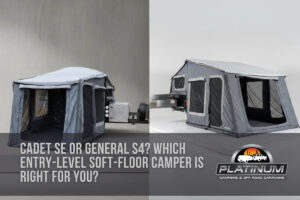
Cadet SE or General S4? Which Entry-Level Soft-Floor Camper Is Right for You?

Quick answer: Choose the Cadet SE if you want the lightest, most affordable way into off-road camping and you don’t mind climbing a ladder to bed. Step up to the General S4 if you want easy step-through bed access, room for more adults, and extra storage and power, and your tow vehicle can handle 2,000kg. Both are genuine off-road soft-floor campers built on the same chassis, suspension and kitchen, so this really comes down to access, space and towing weight. Here is the full breakdown so you can match the right camper to your family and your 4WD. Key Takeaways Cadet SE vs General S4: Side-by-Side Feature Cadet SE General S4 Price (from) $15,899* $17,899* Finance (from) $77/week* $86/week* Sleeps (guide) 2 adults + 4 children 4 adults + 4 children Bed access Ladder Step-through internal stairs Tare weight 1,000kg 1,100kg ATM 1,700kg 2,000kg Payload (approx.) 700kg 900kg Main tent size 5,200 x 2,100mm 5,000 x 2,800mm Power outlets 3 x 12V + 1 USB 5 x 12V + 2 USB Entertainment Bluetooth stereo Built-in entertainment system Pantry drawer No Yes Warranty 5 years structural 5 years structural *Pricing is ex Brisbane collection and excludes dealer delivery and registration. Request a quote to confirm all costs. What Both Campers Share Before the differences, it helps to know how much these two have in common, because it is a lot. Both are Australian-designed soft-floor campers engineered for full off-road use, so neither is a compromise on toughness. Each rides on dual-shock independent suspension with trailing arms and heavy-duty coil springs, a fully galvanised hammertone chassis, and 15-inch 6-stud off-road XD rims. Both use an ARK 2,000kg 50mm ball hitch with a 250kg jockey wheel, giving genuine ground clearance and departure angles for rough tracks. Inside, both deliver the same core comforts: a full stainless-steel kitchenette with a sink, servery, two drawers and a four-burner gas stove, a queen high-density memory-foam mattress, an internal privacy screen, a large fridge slide, an onboard battery with a power management system, a mesh stone guard, a plumbed drawbar tap, and a 1kg fire extinguisher. Setup takes about 7 minutes and packdown around 8 minutes on either model. In short, you are choosing between two versions of the same well-built platform, not two different classes of camper. For background on the format itself, see Platinum’s guide to the benefits of a soft-floor camper trailer. The Defining Difference: Ladder vs Step-Through The single biggest reason to choose one over the other is how you get into bed. The Cadet SE uses a ladder to reach its queen bed. It is simple, it works, and for fit adults and active kids it is a non-issue. If you are young, agile, and travelling light, the ladder saves weight and money. The General S4 uses internal step-through stairs. You walk up into the sleeping area through the camper rather than climbing an external ladder, and you can close the section off for privacy at night. This matters more than it sounds. For older campers, anyone with a sore knee or back, parents doing midnight trips for small children, or anyone who simply values comfort, step-through access is a meaningful upgrade. If bed access is the only thing you are weighing, the question is straightforward: prioritise budget and weight, pick the Cadet; prioritise easy access and comfort, pick the General. Space and Sleeping Capacity Both campers boast a huge open tent, but they are shaped differently. The Cadet’s main tent measures 5,200 x 2,100mm, while the General’s is 5,000 x 2,800mm. The General trades a little length for a lot more width, giving it roughly 14 square metres of tent floor versus the Cadet’s 10.9, about 28% more living space. That extra width is why the sleeping guide differs. The Cadet SE is rated for 2 adults and 4 children, ideal for a couple with kids. The General S4 steps up to 4 adults and 4 children, making it the better pick for larger families, two couples travelling together, or anyone who wants room to spread out on longer trips. Both models offer an optional kids’ room to extend capacity further, so neither locks you in. But if you already know you need to sleep more adults, the General is built for it. Storage and Power Storage is generous on both, thanks to compartmentalised boxes, three full-length 1,700mm pole tubes, and a large fridge slide. The Cadet SE was upgraded from the older Cadet S2 with enclosed sides and seven dedicated storage compartments, so it punches above its price on organisation. The General S4 goes further, marketed as having “more storage than Storage King,” and adds a pantry drawer above the kitchen for cooking supplies and cutlery. Its higher payload also means you can legally carry more gear, which matters on extended trips. Power tells a similar story. The Cadet SE runs 3 x 12V sockets and 1 USB, while the General S4 doubles up with 5 x 12V sockets, 2 USB ports, and a built-in entertainment system. Families running fridges, lights, fans and devices will appreciate the General’s extra capacity. Weight and Towing: This May Decide It Weight is where your tow vehicle gets a vote. Understanding two numbers makes this easy. Tare is the empty weight of the camper. ATM (Aggregate Trailer Mass) is the most it can legally weigh fully loaded. The gap between them is your usable payload. The Cadet SE has a tare of 1,000kg and an ATM of 1,700kg, leaving around 700kg of payload. The General S4 has a tare of 1,100kg and an ATM of 2,000kg, for roughly 900kg of payload. That 300kg ATM difference is significant. A 1,700kg Cadet sits comfortably within the braked towing limit of many mid-size SUVs, giving you towing headroom. A 2,000kg General sits right at the limit of a 2,000kg-rated vehicle, so it leans toward a larger SUV or 4WD with capacity to spare. Both campers exceed 750kg, so they must be towed with a braked setup.

Read More »
Platinum Camper Trailers for Grey Nomads
Buying Support
nico

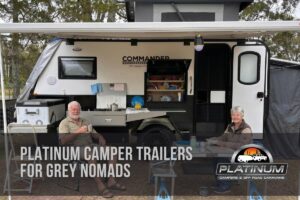
Platinum Camper Trailers for Grey Nomads

The best Platinum camper trailers for grey nomads are the Commander Hybrid and the Discovery E1, with the General S4 a strong value pick for couples who want easy access and quick setup. These models combine off-grid capability, comfortable living space, and manageable towing weights, the three things that matter most when you are travelling for months at a time. Grey nomads, retired or semi-retired Australians aged 50 and over who tour the country for extended periods, are one of the most committed groups on the road. Older Australians travelling domestically in self-sufficient recreational vehicles for extended periods have been referred to as grey nomads for more than two decades, with the term applying to those who tour for a minimum of three months. Choosing the right rig is the difference between a relaxed Big Lap and a trip cut short by setup hassle or a poorly matched tow vehicle. This guide breaks down which Platinum models suit the grey nomad lifestyle, what to look for in setup and power systems, and how to match a camper to your vehicle legally and safely. Key Takeaways What Makes a Camper Trailer Right for Grey Nomads? The right camper trailer for grey nomads prioritises easy setup, off-grid self-sufficiency, comfortable sleeping and seating, and a towing weight your vehicle can handle for thousands of kilometres. Comfort and reliability outrank raw size, because most grey nomads travel as couples and cover long distances at an unhurried pace. Extended travel is the defining feature of this lifestyle. Retirees travel for longer and spend more nights per trip than any other group, sustaining regional tourism outside peak holiday periods. A camper that is quick to pitch and pack means less physical strain at the end of a long driving day, which becomes more important the longer you stay on the road. What’s Up Downunder Self-sufficiency is the second priority. Many grey nomads prefer free camping and roadside stops over paid parks, so a camper needs onboard water, solid battery storage, and a kitchen that works anywhere. If you are weighing your options, our guide to whether camper trailers are still worth it covers the value case in detail. The market backs this up. By 2021, more than 750,000 recreational vehicles were registered in Australia, and tourism data showed 11.8 million domestic camping and caravanning trips in a single year, with 29% of those taken by people aged 55 and over. According to the Caravan Industry Association of Australia, this segment remains a backbone of regional travel. Best Platinum Camper Trailers for Grey Nomads The standout choices are the Commander Hybrid for off-grid comfort, the Discovery E1 for living space, and the General S4 for accessible, affordable touring. Each suits a slightly different travel style and budget. The Commander Hybrid blends the comfort of a caravan with the agility of a camper trailer, making it the premium pick for grey nomads planning long off-grid stints. It offers hard-sided protection, a permanent bed, and the storage capacity needed for weeks between resupply. See the Commander Hybrid for full specifications, and read how a hybrid camper trailer lifts the touring experience. The Discovery E1 is a forward-fold hard floor camper that maximises living space and comfort. Its generous internal area and quick setup make it ideal for couples who want room to spread out without stepping up to a full caravan. View the Discovery E1 to compare layouts. The General S4 is a step-through soft floor camper built around accessibility and storage. The step-through design reduces the bending and climbing that can be a real consideration for older travellers, and it sits at a friendlier price point. Explore the General S4 for details. For couples who value the fastest possible setup, the rear-fold Chase S5 is purpose-built for compact towing and quick camps, a strong fit for those who relocate often. Our breakdown of the best camper for couples puts these options side by side. Model Type Best for grey nomads Setup Why it suits the lifestyle Commander Hybrid Hybrid Extended off-grid travel Fast Caravan comfort, off-road agility, big storage Discovery E1 Forward fold hard floor Couples wanting living space Quick Maximum internal comfort, family-friendly General S4 Step-through soft floor Easy access, value Moderate Step-through entry, strong storage, affordable Chase S5 Rear fold hard floor Frequent movers Very fast Compact towing, rapid setup Cadet SE Soft floor Lightweight budget touring Moderate Light, affordable entry point Easy Setup and Low-Maintenance Living For grey nomads, a camper that sets up in minutes and needs little upkeep is worth more than extra square metres. Hard floor and hybrid designs pitch faster than traditional soft floor campers, which reduces fatigue on travel-heavy days. Platinum’s rear-fold and forward-fold models are engineered for speed, with the bed and main living area deploying as the camper opens. If setup time is your deciding factor, see which is the quickest to set up across the range. Low maintenance keeps you on the road instead of in a workshop. Regular servicing of bearings, brakes, and suspension is essential when you are covering tens of thousands of kilometres. Our guide on how often to service your camper sets out a sensible schedule for long-distance travel. Australian build quality matters here too. Platinum campers use a hot-dipped galvanised chassis, meaning the frame is coated in zinc to resist rust, and independent suspension, where each wheel moves separately for a smoother ride on rough roads. These features extend the camper’s working life across corrugated outback tracks. Off-Grid Power for Extended Free Camping Reliable off-grid power is non-negotiable for grey nomads who free camp, and the proven setup is solar panels paired with a lithium battery and a DC-DC charger. This combination keeps fridges, lights, and devices running for days without mains power. Solar is the primary source. A well-sized solar array recharges your batteries during daylight, and our overview of solar power explains how to match panel capacity to your usage. Storage is the other half. Lithium batteries hold more

Read More »
0
0
Your Cart
Your cart is empty