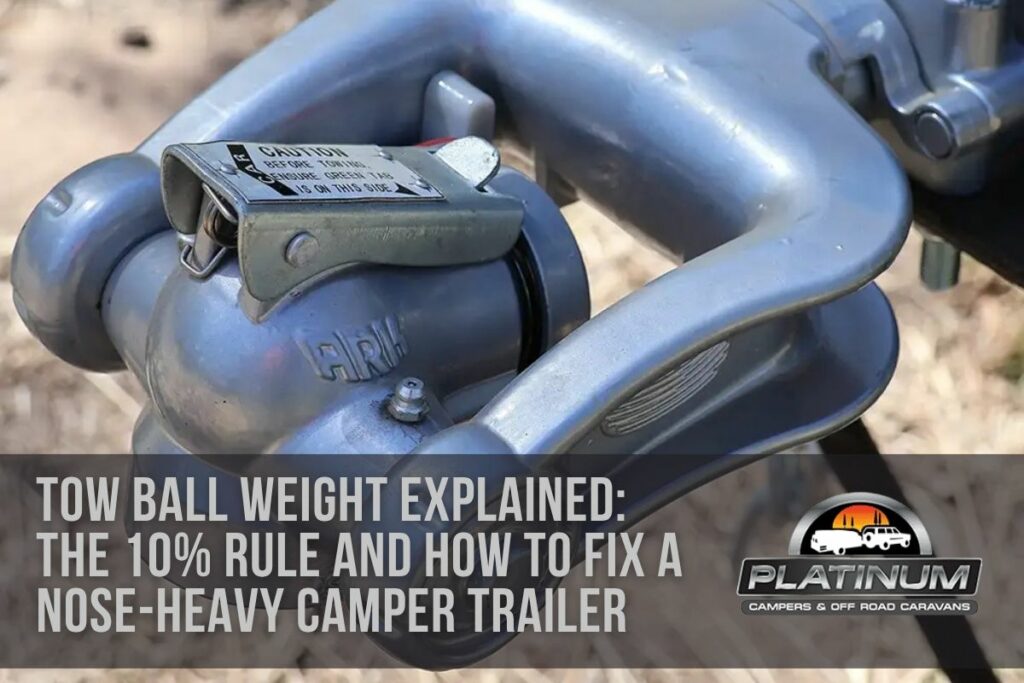
Tow ball weight is the downward force your camper trailer places on the vehicle’s tow ball when hitched. Get it wrong and you risk poor handling, reduced braking, illegal overloading of your vehicle’s payload, or a dangerous sway. Get it right and your rig tracks straight, stays within legal limits and tows predictably on Australian roads and tracks.
This guide explains tow ball weight (also called tow ball mass or towball download), the widely used 10% rule, how to measure it with tow ball weight scales, and practical ways to fix a nose-heavy camper trailer.
Overview
You will learn what tow ball weight is, how it links to ATM, GTM, GVM and payload, why the 10% guideline exists, how to weigh ball mass accurately, how packing shifts the balance, and how to correct a nose-heavy setup. You will also see how Platinum Campers models and load planning fit into safe matching of trailer and tow vehicle.
Key Takeaways
- Tow ball weight is the vertical load on the coupling; it counts against your vehicle’s payload and GVM.
- The 10% rule targets roughly 10% of the trailer’s loaded ATM as ball mass for many light trailers, within manufacturer limits.
- Nose-heavy setups overload the rear axle and reduce steering feel; tail-heavy setups invite sway.
- Tow ball weight scales give a real number in minutes; guessing from “feel” is not enough.
- Move dense gear forward or aft, manage water and gas, and respect both trailer and vehicle plates.
- Always stay under the lowest applicable limit: coupling, towbar, vehicle TBM rating, and remaining payload.
What Is Tow Ball Weight (and Towball Download)?
Tow ball weight is the static downward load transferred through the coupling onto the tow ball or hitch receiver when the trailer is coupled and sitting level. In Australian towing language you will also hear tow ball mass (TBM) and towball download. They describe the same vertical force, not the trailer’s total mass.
When the trailer is uncoupled, that same mass sits on the jockey wheel. When coupled, it becomes part of the tow vehicle’s rear load. It must be subtracted from the weight you can still carry as people, luggage and accessories in the car.
These related weight terms all affect each other:
| Term | Meaning | Why it matters for ball weight |
| Tare | Trailer weight as delivered, empty of payload and usually without fluids | Baseline before you pack |
| ATM | Max allowed trailer mass uncoupled (including everything on the trailer) | 10% rule is often applied to loaded ATM |
| GTM | Max trailer mass on its axles when coupled | Ball weight is not all on the trailer axles when hitched |
| TBM / tow ball weight | Downward load on the tow ball | Eats vehicle payload; must not exceed ratings |
| GVM | Max allowed mass of the loaded tow vehicle | TBM counts inside GVM |
| Payload | GVM minus kerb (and other deductions as specified) | Passengers + cargo + TBM must fit |
| GCM | Max combined vehicle + trailer mass | Caps the whole rig |
For plain definitions of ATM, GTM, GVM and payload, read our camper trailer weights and towing capacity guide before you finalise a purchase.
Towball download is simply another name for that downward ball load. If someone asks for “download,” they want the kilogram figure on the ball, not a software file.
Why Tow Ball Weight Matters on Australian Roads
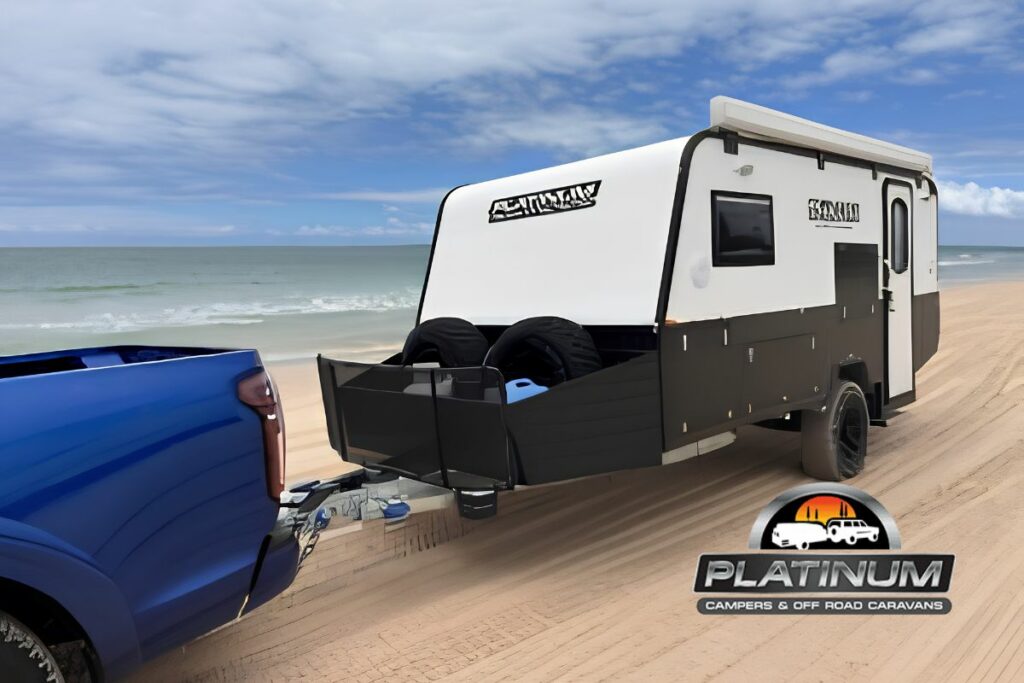
Correct tow ball weight keeps the hitch planted so the trailer follows rather than steers the car. Too little ball weight (tail heavy) lets the trailer yaw and amplify sway from wind, trucks or corrugations. Too much (nose heavy) squats the rear, lightens the front axle, dulls steering, lengthens stopping distances and can overload the towbar, coupling or rear tyres.
Legally and practically you must not exceed:
- The vehicle manufacturer’s maximum tow ball download
- The towbar and tongue rating
- The coupling rating
- The trailer’s design ball mass range if stated
- Remaining payload inside GVM
State road rules still require a safe, compliant combination. Manufacturer ratings on the vehicle plate and trailer compliance plate are the hard limits. Industry rules of thumb never override those numbers.
Off-road and beach runs add pitch and bounce, so a ball mass that felt fine on the highway can spike on corrugations. That is another reason to measure loaded ball weight as you will actually travel, then leave margin. For soft surfaces, pair balance with sensible beach towing technique and tyre pressures.
The 10% Rule for Tow Ball Weight
The 10% rule means many light trailers tow most stably when tow ball weight is about 10% of the trailer’s actual loaded ATM, within the limits on both vehicle and trailer.
Example method (illustrative only): if your loaded trailer mass is 1,400 kg and sits under ATM, a starting target is around 140 kg on the ball, then verify against the car’s maximum TBM and your remaining payload.
How to apply the 10% rule safely
- Weigh or calculate loaded trailer mass; never exceed ATM.
- Calculate 10% of that loaded mass as a target band, not a law.
- Compare with the lowest of: vehicle TBM limit, towbar rating, coupling rating.
- Confirm passengers + cargo + ball weight still fit inside GVM/payload.
- Measure real ball weight with scales after packing.
- Adjust load position until you are inside the safe band.
Tow ball weight is commonly around 10% of the loaded trailer weight, though it varies with trailer length, suspension and coupling type; check your vehicle and trailer manuals. Caravans and long hybrids can behave differently from compact camper trailers. Always prefer the trailer and vehicle makers’ stated ball mass guidance when they publish it.
If 10% of ATM is higher than your vehicle’s rated tow ball download, you cannot “take the 10%.” You must reduce trailer mass, change load distribution only within safe design, or choose a lighter trailer and match your camper trailer to your tow vehicle.
Nose-Heavy vs Tail-Heavy: What You Are Fixing
Nose-heavy camper trailer (ball weight too high)
Symptoms
- Rear of the tow vehicle squats; headlight aim lifts
- Steering feels light; front tyres lose bite
- Brake dive feels worse; braking can feel less stable, especially in emergency stops
- Jockey wheel is hard to lift or the coupling sits heavily on the ball
- Measured TBM above vehicle or towbar limit
Main risks
- Overload of towbar, receiver, coupling or rear axle
- Reduced high-speed stability in a different way than sway (understeer, poor front grip)
- Illegal GVM/payload breach even if ATM is fine
Tail-heavy camper trailer (ball weight too low)
Symptoms
- Trailer feels nervous or “floaty”
- Sway starts easily from side winds or overtaking trucks
- Rear of the car looks high; coupling may look light
- Measured TBM well under about 10% of loaded mass (and below the trailer’s preferred range)
Main risks
- Oscillation and loss of control
- Longer recovery time after a steering input
- Uneven braking behaviour
A stable camper sits level, within ratings, with ball weight in the sensible band. Level stance alone is not enough if the kilogram figure is wrong.
How to Measure Tow Ball Weight with Scales
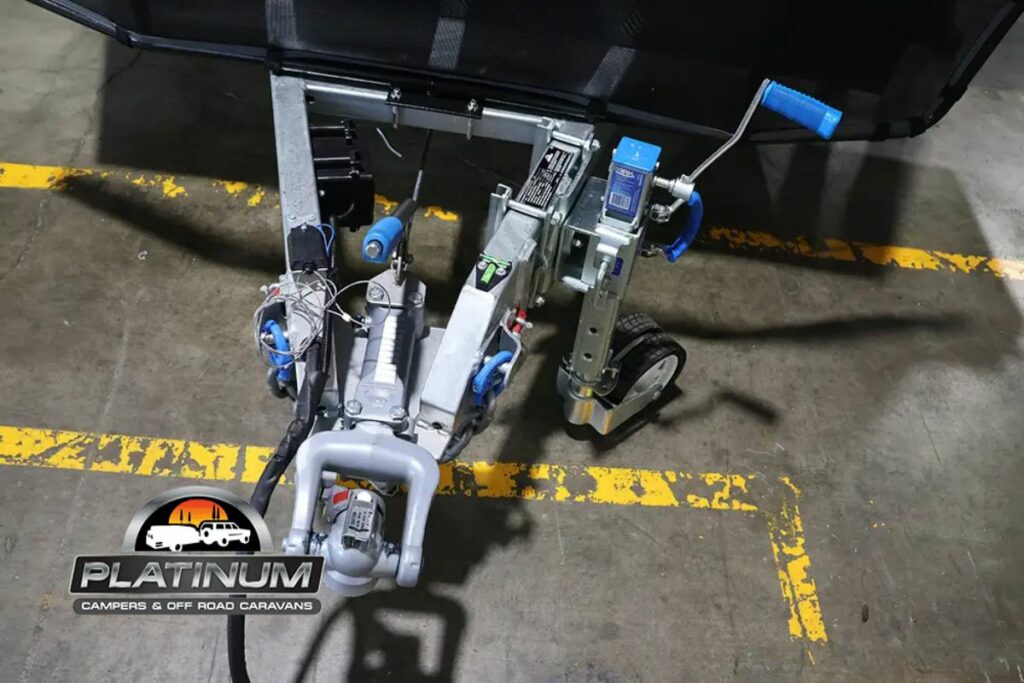
Guessing by bumper height is unreliable. Tow ball weight scales (dedicated ball weight scales or a suitable load scale under the jockey wheel/coupling) give a repeatable number.
Method A: Dedicated tow ball weight scale
- Pack the camper exactly as you will travel (water, gas, food, recovery gear, annexes).
- Park on level ground; chock wheels.
- Unhitch or support per the scale instructions so the coupling load sits on the scale.
- Record the reading in kilograms.
- Compare to vehicle TBM limit, towbar rating and your 10% target band.
- Adjust load and re-weigh until compliant.
Method B: Jockey wheel / pad scale
- On level ground, with trailer uncoupled and brakes applied, place a rated scale under the jockey wheel foot (or use a proper load pad).
- Raise or lower so the coupling height matches normal tow height and the trailer sits level.
- Read the vertical load. That figure approximates tow ball weight for a level trailer.
- Repeat after any major repack.
Method C: Public weighbridge (whole-rig check)
- Weigh vehicle alone (loaded with people and cabin gear you will carry).
- Weigh vehicle + trailer coupled.
- Weigh trailer axles only if the bridge layout allows.
- Use the differences, with care, to understand axle loads; still use a ball scale for a direct TBM number when possible.
Measurement tips that prevent bad data
- Measure loaded for the trip, not empty tare ball weight only.
- Keep the trailer level; a nose-down stance skews readings.
- Include full or typical water and gas if that is how you drive.
- Recheck after buying heavy accessories (second spare, toolboxes, generators).
- Do not exceed the scale’s rated capacity; use equipment designed for ball mass.
Write the number on a card in the glovebox: target band, absolute maximum TBM for your vehicle, and last measured value. Recheck when your packing style changes.
How Packing and Design Change Tow Ball Weight
Ball weight is not fixed at the factory once you add payload. Every kilogram you place ahead of the axle cluster increases towball download; every kilogram behind decreases it. Water tanks, jerry cans, kitchens, fridges and recovery gear are the big movers.
High-impact load items
- Fresh water (heavy and often forward or central)
- Liquid waste if fitted
- Gas bottles on the drawbar (strong nose-down effect)
- Chain bags, maxtrax, steel tools on the A-frame
- Rear storage, bikes, outboards, or heavy boxes behind the axle
- Annex walls and poles packed at extremes of the tub
Camper layout patterns
- Rear fold hard floors often keep a compact tow length; pack still decides TBM. Explore our rear fold camper trailers if you want quick setup with careful load planning.
- Forward fold designs change mass position when open vs closed; weigh in the towing configuration.
- Soft floor campers can hide heavy crates low in the tub; keep dense items centred over the axle where possible. Browse our soft floor camper trailers to compare tub layouts.
- Double fold family layouts add space and payload temptation; stay honest about ATM when packing double fold camper trailers for family trips.
Empty ball mass on the compliance discussion is only a start. Your real tow ball weight is the packed number.
How to Fix a Nose-Heavy Camper Trailer

Move weight rearward (without going tail-heavy), reduce unnecessary front mass, and confirm with scales while staying inside ATM, GTM and vehicle TBM limits.
Step-by-step correction
- Measure current tow ball weight loaded.
- Note limits on vehicle, towbar, coupling and trailer ATM.
- Shift dense cargo from drawbar and extreme front storage to lockers nearer or slightly behind the axle centre, still low and secured.
- Reduce drawbar junk you do not need every day (extra chains, duplicate tools, full jerry cans if a rear rack is rated and safer for balance).
- Manage water: travel with partial front tank if safe and planned, or use water strategy that does not pin the nose beyond limits. Never compromise drinking water safety for a number.
- Gas bottles: keep required gas, but avoid stacking extra steel on the A-frame if ball mass is already high.
- Avoid illegal “fixes”: cutting springs, exceeding towbar ratings, or removing safety chains is not a solution.
- Re-weigh and road-test at modest speed on a quiet road; check mirrors for squat and feel for light steering.
- If still over limit, permanently remove payload, leave gear at home, or choose a lighter camper. Do not rely on weight distribution hitches to justify exceeding ratings unless the vehicle and hitch makers explicitly allow the configuration.
Load security while you rebalance
Shifting boxes helps only if they cannot slide. A crate that moves rearward under braking can suddenly drop ball weight and start sway. Use positive latches and straps, and follow our guide to securing your camper trailer load, so the measured TBM stays the TBM you drive with.
When the trailer is nose-heavy empty
If tare ball mass is already near your vehicle’s maximum, that trailer is a poor match for the car even before camping gear. First-time buyers should treat this as a selection issue, not a packing puzzle. Work through our first-time towing tips and compare lighter options in the Platinum camper trailer range, including compact builds suited to smaller tow vehicles.
Hitch and height checks
Incorrect coupling height can transfer weight oddly and upset trailer attitude. Confirm receiver height, use appropriate drop/raise if specified, and complete hitch safety checks before long trips. Polyblock and other couplings still need correct engagement, pins and chains even when ball mass is perfect.
Tow Ball Weight, Payload and Real-World Matching
A common mistake is buying to the vehicle’s braked towing figure while ignoring ball mass and payload.
Simplified payload view
Remaining cabin payload ≈ vehicle payload capacity − passengers − cabin cargo − accessories − tow ball weight
If your family and fridge already use most of the payload, a high TBM will tip you over GVM even when the trailer is under ATM. That is why lightweight campers and honest packing matter as much as headline towing capacity.
Practical matching steps:
- Read vehicle handbook: GVM, GCM, towing capacity, max ball download.
- Weigh or research trailer tare, ATM and typical packed TBM.
- Add your real family mass and recovery gear.
- Keep reserve for souvenirs, wet canvas and full water when needed.
- Prefer a camper with margin, not one that only works empty.
For model shortlisting, pair this article with our camper trailer buyer’s guide and, when you are ready, contact the Platinum Campers team to talk through the limits for your exact vehicle.
Quick Reference: Targets vs Hard Limits
| Check | Soft target | Hard limit |
| Ball mass vs loaded ATM | Commonly around 10%, varies; check manuals | Never above rated TBM of vehicle/towbar/coupling |
| Trailer mass | Efficient packing | ATM / GTM on plate |
| Vehicle mass | Comfortable ride height | GVM |
| Combination | Stable, no sway | GCM |
| Measurement | After every major repack | Before remote trips |
Practical Checklist Before You Tow
- Trailer loaded as for the trip
- Tow ball weight measured with scales
- TBM under vehicle, towbar and coupling ratings
- Near 10% of loaded ATM unless maker says otherwise
- GVM/payload OK with people and cabin gear
- ATM not exceeded
- Load strapped so mass cannot migrate
- Coupling height level; chains and plugs secure
- Lights, brakes and torque of wheel nuts checked
Frequently Asked Questions
What is tow ball weight on a camper trailer?
Tow ball weight is the downward force the hitched camper applies to the vehicle’s tow ball. It is also called tow ball mass (TBM) or towball download. It counts towards the tow vehicle’s GVM and must stay within the vehicle, towbar and coupling ratings.
What does towball download mean?
Towball download means the same vertical load as tow ball weight: how many kilograms press down on the ball or receiver. It is not a software download. Ask for the figure in kg and confirm it against your vehicle’s maximum rated download.
Is the 10% rule a legal requirement in Australia?
No. The 10% rule is a common stability guideline for many light trailers. Legal compliance depends on manufacturer ratings, ATM/GTM/GVM/GCM limits and road rules. If 10% exceeds your vehicle’s rated ball mass, the vehicle limit wins.
How do I measure tow ball weight at home?
Use tow ball weight scales on level ground with the camper packed for travel and sitting level. Dedicated ball scales or a rated scale under the jockey wheel at correct coupling height both work. Re-check after major packing changes.
How do I fix a nose-heavy camper trailer?
Shift heavy items rearward towards or slightly behind the axle, reduce unnecessary drawbar mass, manage water and gas placement, then re-weigh. Do not exceed ATM or vehicle TBM limits. If empty ball mass is already too high, choose a lighter trailer or a vehicle with a higher rated download.
Does water in the front tank increase tow ball weight?
Yes. Water is dense. A forward tank raises towball download as you fill it. Measure ball weight with your typical water load and plan fills around handling and ratings, not only camping convenience.
Does tow ball weight reduce how much I can carry in the car?
Yes. Ball mass is applied to the vehicle through the tow system and must be allowed for inside GVM and payload along with passengers and cargo. High TBM can leave almost no legal cabin payload.
What is more dangerous, nose-heavy or tail-heavy?
Both are dangerous in different ways. Tail-heavy setups are known for sway. Nose-heavy setups overload the rear, unload the front and can exceed structural ratings. Aim for the correct band, not an extreme either way.
Should I use a weight distribution hitch to fix high ball weight?
Only if your vehicle and hitch manufacturers allow it for your combination. A distribution hitch redistributes leverage; it does not raise legal ratings or fix an over-ATM trailer. Measure, pack correctly and respect plates first.
How often should I recheck tow ball weight?
Recheck when you change passengers, add accessories, alter tank levels for a long trip, or pack for a different style of tour. A quick scale check is cheaper than a handling surprise on the highway.
Find a camper that suits your vehicle
Choose a camper that leaves real margin on ATM and tow ball weight for your vehicle, then pack with scales, not guesswork. Explore the current camper trailer range or speak with the team about matching ball mass, payload and layout to the way you actually travel.
Sources
- Vehicle and trailer manufacturer compliance plates and handbooks (primary legal limits for your combination)
- NSW Government towing rules (road rules and safe towing context)
- Queensland Government towing guidelines (state towing safety guidance)
- National Heavy Vehicle Regulator and state road authority materials for combination mass concepts where applicable to your class of vehicle