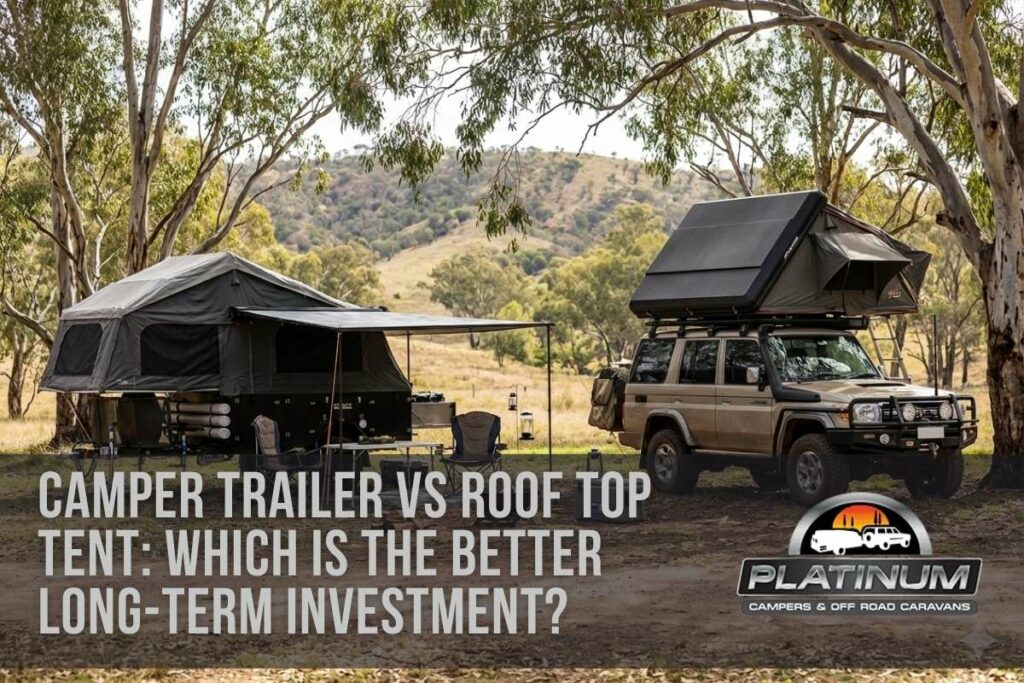
Introduction
Choosing between a camper trailer and a roof top tent (RTT) is one of the most common decisions Australian adventurers face. Both options promise freedom on the road, but they differ significantly in cost, comfort, convenience, and long-term value. For families, couples, and solo travellers weighing up their next camping purchase, understanding these differences is essential to making a decision you won’t regret years down the track.
This guide compares camper trailers and roof top tents across the factors that matter most, upfront costs, ongoing expenses, setup convenience, comfort, durability, and resale value. Whether you’re exploringQueensland’s best campsites or tackling remote outback tracks, you’ll discover which option delivers the best return on your investment.
Overview
This article covers the key differences between camper trailers and roof top tents, including initial purchase costs, total cost of ownership, setup and pack-down times, living space and comfort, off-road capability, storage solutions, and long-term resale value. By the end, you’ll have a clear picture of which option aligns with your camping style, budget, and future plans.
Key Takeaways
- Camper trailers have higher upfront costs but offer superior comfort, storage, and resale value over time.
- Roof top tents are affordable entry points but limit vehicle usability and offer less weather protection.
- For frequent campers and families, camper trailers typically deliver better value per trip over 5+ years.
- RTTs suit occasional weekend warriors with smaller vehicles and limited budgets.
- Both options require consideration of your vehicle’s towing capacity and weight limits.
What Is a Roof Top Tent?
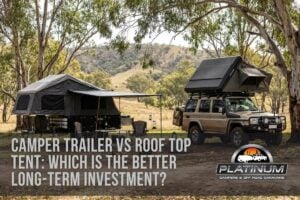
A roof top tent mounts directly onto your vehicle’s roof rack, folding out to create a sleeping platform elevated off the ground. RTTs gained popularity for their simplicity, drive to camp, unfold, and sleep. They range from basic manual-fold designs to elaborate hardshell units with built-in mattresses. Most RTTs accommodate two adults comfortably, though family-sized versions exist at premium prices.
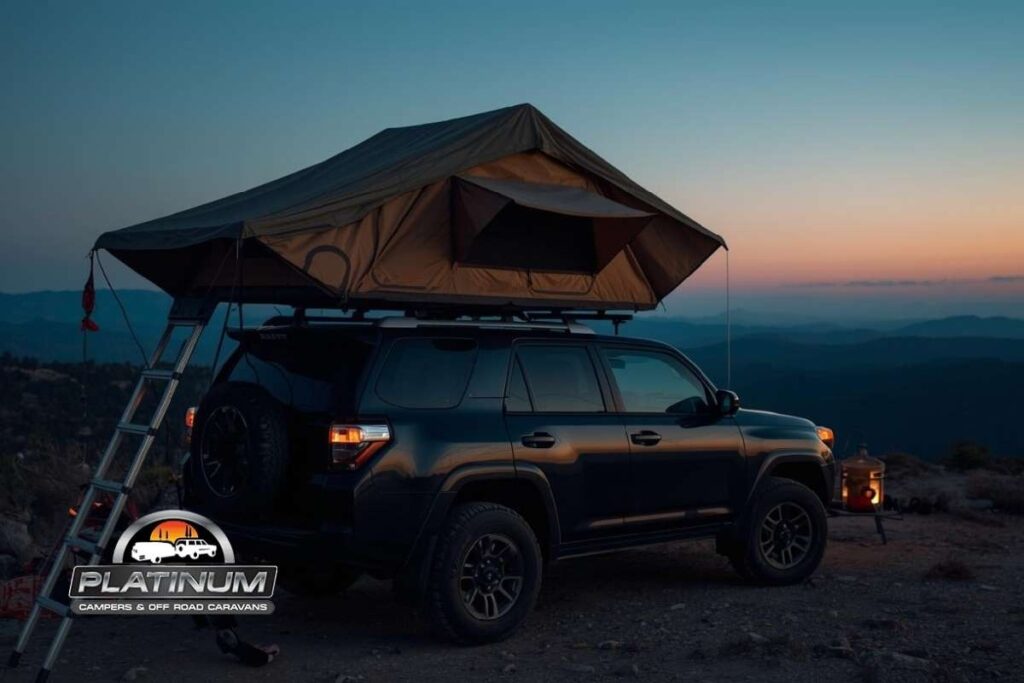
The appeal lies in their compact nature when folded and the speed of basic deployment. However, RTTs permanently occupy your roof space, affect vehicle handling, and provide sleeping quarters only; cooking, storage, and living areas require separate solutions.
What Is a Camper Trailer?
A camper trailer is a purpose-built, towable unit designed for comfortable outdoor living. Australian camper trailers come in several configurations, including soft floor and hard floor models, each engineered to handle Australian conditions. Options range from compact rear-fold designs like the Chase S5 to spacious double-fold models like the Chariot E1.
Camper trailers integrate sleeping quarters, kitchens, storage systems, and often annexes into one package. Understanding the differences between forward-fold and rear-fold designs helps buyers match features to their needs.
Upfront Cost Comparison
Initial purchase price often drives buying decisions, though it tells only part of the story. Entry-level roof top tents start around $800-$1,500, with quality hardshell units ranging from $2,500-$6,000. Premium RTTs with accessories can exceed $8,000.
Camper trailers represent a larger initial investment. Quality soft floor models start under $15,000, whilecapable hard floor campers are available under $20,000. Premium models with full off-road capability and comprehensive features range from $20,000-$40,000+. However, this higher entry point includes integrated kitchens, storage, sleeping systems, and often 12V electrical setups, components RTT owners must purchase separately.
When calculating true upfront costs, RTT buyers should add roof rack upgrades ($500-$2,000), awnings ($400-$1,500), portable fridges ($600-$2,000), cooking equipment ($300-$800), and storage solutions ($200-$500). These additions narrow the gap considerably, often bringing total RTT setup costs to $5,000-$12,000.
Total Cost of Ownership Over 5-10 Years
Long-term value emerges when examining costs across typical ownership periods. Beyond purchase price, both options incur ongoing expenses that affect their true investment value.
Roof top tent running costs include replacement mattresses and covers every 3-5 years ($200-$500), potential roof rack maintenance or replacement, and increased fuel consumption due to aerodynamic drag and added weight. The constant roof load also accelerates wear on vehicle suspension components. Most RTT owners report 5-15% increases in fuel consumption, which compounds significantly over thousands of kilometres.
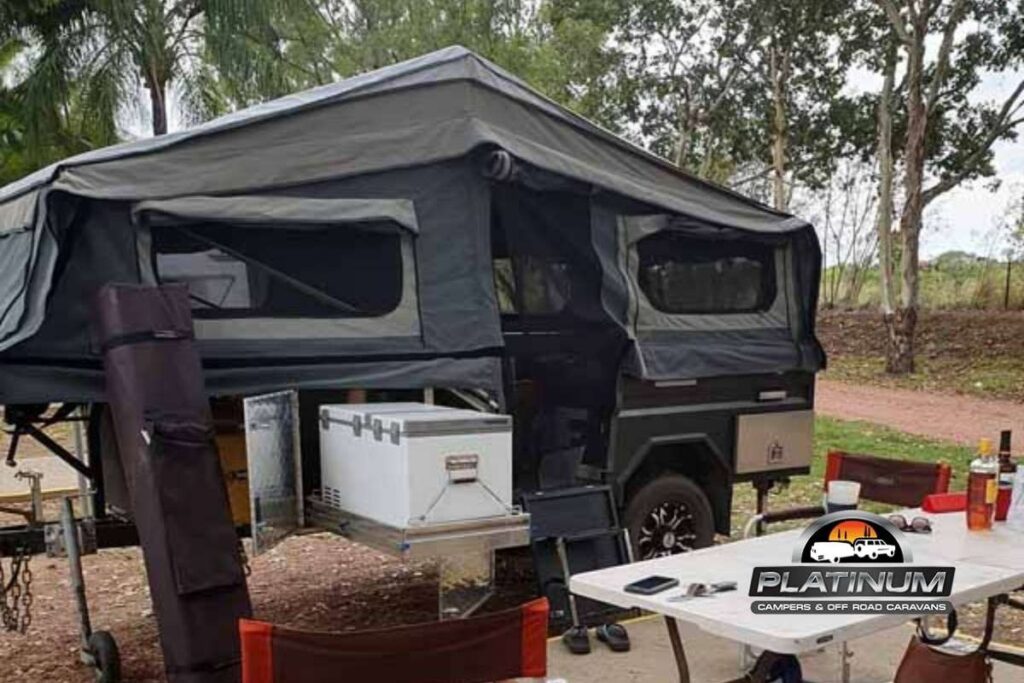
Camper trailer ownership involvesregular servicing, typically annual wheel bearing checks, brake inspections, and canvas treatment. These services cost $150-$400 annually depending on usage intensity.Canvas maintenance every few years adds $100-$300. Registration andinsurance costs typically run $300-$600 annually.
Crucially, camper trailers disconnect from your vehicle between trips, preserving your car’s roof, suspension, and fuel efficiency for daily driving. This separation also means your vehicle remains fully functional while the camper undergoes maintenance or modifications.
Setup Time and Convenience
Time at camp matters, especially after long drives. RTT manufacturers often claim 30-second setup times, which applies only to unfolding the tent itself. Practical setup, including deploying ladders, arranging bedding, setting up awnings, organising cooking equipment, and establishing a functional camp, typically takes 15-30 minutes.
Modern camper trailers have dramatically reduced setup times. Quick-setup designs can be camp-ready in under 5 minutes for basic overnight stops. Understanding realistic setup expectations helps buyers compare fairly. Rear-fold models like the Quest E1 excel at rapid deployment, while larger family setups with full annexes take longer but deliver substantially more living space.
Pack-down reveals greater differences. RTTs require removing and stowing all bedding before folding, problematic with damp sleeping bags or when departing early. Camper trailers allow quick pack-down with bedding remaining in place, ready for the next night’s camp.
Comfort and Livability
Comfort directly affects how often you’ll actually use your investment. RTTs provide elevated sleeping platforms that keep you off the ground and away from crawling insects. However, sleeping space is typically confined to the tent footprint, with limited headroom and no weather-protected living area beneath.
Rainy days expose RTT limitations severely. Cooking under a vehicle awning while sleeping quarters remain inaccessible creates frustrating camping experiences. Temperature control proves challenging without insulated walls, and noise from wind and rain directly impacts sleep quality.
Camper trailers deliver ground-level living with integrated features that transform camping comfort. Built-in kitchens with proper benchtops, quality accessories, and weather-protected cooking areas make meal preparation enjoyable regardless of conditions. Models offering kids’ rooms turn family camping into practical adventures rather than endurance tests.
For couples specifically, compact camper trailers designed for two offer the ideal balance of simplicity and comfort without excess bulk.
Storage and Organisation
Storage capacity profoundly affects camping enjoyment and trip duration capability. RTT setups scatter gear across vehicle interiors, external boxes, and improvised solutions. Accessing buried equipment becomes a frustrating exercise, and load security requires constant attention.
Camper trailers provide dedicated, organised storage solutions purpose-built for camping equipment. Integrated kitchen storage, under-bed compartments, and external toolboxes keep everything accessible and protected. Creative storage approaches maximise every available space.
This organisation extends trip capability. Well-designed camper trailers comfortably support extended adventures, weeks rather than weekends, because provisions, clothing, and equipment have proper homes.Packing efficiently becomes straightforward when storage systems match gear requirements.
Off-Road Capability
Australian adventures often demand genuine off-road capability. RTTs add significant weight high on your vehicle, raising the centre of gravity and affecting stability on uneven terrain. Quality roof racks and proper installation partially mitigate risks, but physics limits how confidently you can tackle challenging tracks with elevated loads.
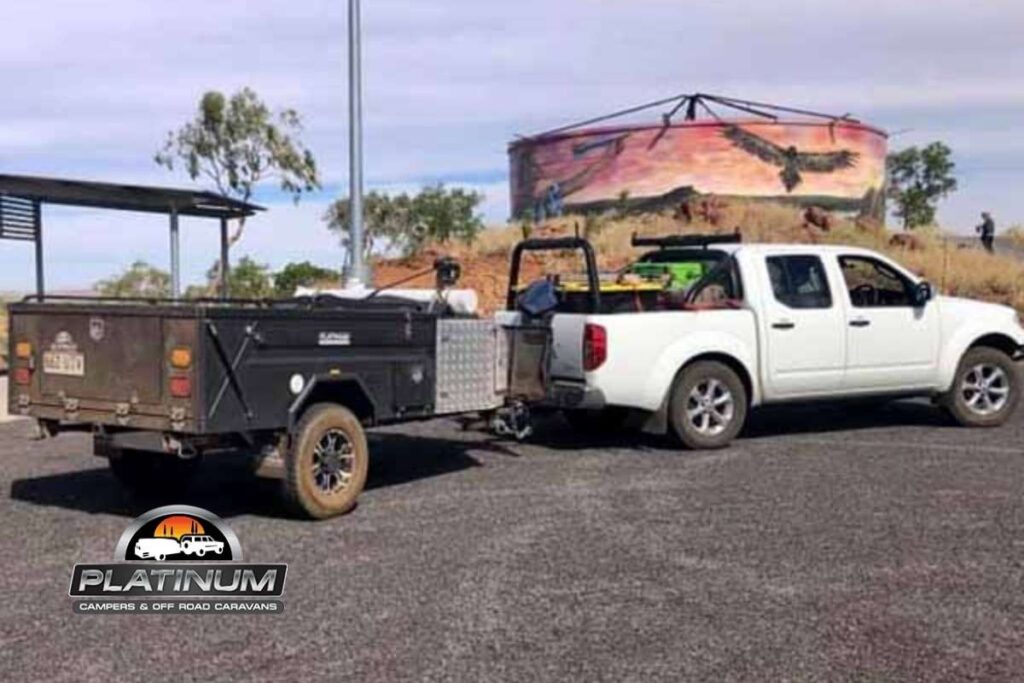
Purpose-built off-road camper trailers feature independent suspension, reinforced chassis, and appropriate ground clearance. Understanding weight distribution and towing dynamics ensures safe travel across varied terrain. Quality camper trailers track predictably behind tow vehicles, and their lower centre of gravity provides stability that roof-heavy configurations cannot match.
For serious outback exploration, hybrid camper trailers combine off-road capability with caravan-style comfort, delivering extended off-grid capability that neither RTTs nor basic campers can match.
Resale Value and Longevity
Investment value crystallises at resale time. Roof top tents depreciate rapidly, typically losing 40-60% of value within three years. Fabric degradation, mounting wear, and evolving designs make older RTTs difficult to sell at meaningful prices. The secondhand market floods with barely-used units from owners who discovered RTT limitations through experience.
Quality camper trailers hold value remarkably well. Well-maintained used campers regularly sell for 60-80% of original price after several years of use. Strong demand for proven brands and models creates liquid resale markets where quality units find buyers quickly.
Longevity compounds this advantage. Camper trailers built for Australian conditions routinely deliver 15-25 years of service with proper maintenance. Canvas, bearings, and consumables require periodic attention, but fundamental structures remain sound for decades. Understanding maintenance fundamentals protects your investment and ensures reliable performance throughout ownership.
Which Option Suits Different Camping Styles?
Choose a Roof Top Tent If:
You camp occasionally, perhaps 5-10 nights annually, and prioritise low initial cost over long-term value. RTTs suit minimalist campers comfortable with basic facilities, owners of vehicles unsuitable for towing, and adventurers who value keeping all equipment in one unit for spontaneous departures. They work well for solo travellers or couples without children who prioritise simplicity over comfort.
Choose a Camper Trailer If:
You camp regularly and value comfort, convenience, and long-term value. Families with children, couples planning extended adventures, and anyone tackling remote Australian destinations benefit from camper trailer capabilities. If you’re asking whether camper trailers remain worthwhile in 2025, the answer for frequent campers is definitively yes.
For those uncertain about specific requirements, key questions to consider before buying help clarify which features matter most for your camping style.
Making the Investment Decision
Long-term investment value favours camper trailers for regular campers. When comparing cost-per-use across typical ownership periods, camper trailers deliver superior value once annual camping exceeds approximately 15-20 nights. The combination of comfort, convenience, durability, and resale value creates compelling economics despite higher initial costs.
Consider a practical example: A quality hard floor camper trailer at $18,000 used for 25 nights annually over 8 years delivers 200 nights of camping. Resale at $12,000 means net cost of $6,000, or $30 per night for comfortable, well-equipped camping. An RTT setup costing $6,000, resold for $2,000 after the same period, costs $20 per night but with significantly reduced comfort and capability.
The per-night cost difference narrows considerably while comfort, storage, and capability gaps remain substantial.
| Factor | Roof Top Tent | Camper Trailer |
| Initial Cost | $2,000-$8,000 (complete setup) | $15,000-$40,000 |
| 5-Year Resale Value | 40-50% of purchase | 65-80% of purchase |
| Setup Time | 15-30 minutes (full camp) | 5-30 minutes (varies by model) |
| Comfort Level | Basic sleeping only | Complete living system |
| Best For | Occasional weekend camping | Regular and extended trips |
Frequently Asked Questions
Is a camper trailer cheaper than a roof top tent over 10 years?
For campers averaging 15+ nights annually, yes. Higher resale values, integrated features eliminating accessory purchases, and preserved vehicle condition make camper trailers more economical long-term despite higher upfront costs.
Can I take a roof top tent off-road?
Yes, but elevated weight affects vehicle stability on challenging terrain. Understanding weight dynamics helps assess whether your specific vehicle and RTT combination suits intended tracks safely.
How long do camper trailers last compared to RTTs?
Quality camper trailers routinely deliver 15-25 years of service with proper maintenance. RTTs typically require replacement or significant refurbishment after 5-8 years due to fabric and mechanism wear.
What’s the best camper trailer for a small vehicle?
Lightweight camper trailers designed for smaller vehicles offer excellent capability without exceeding towing limits. Models under 750kg ATM suit many popular SUVs and wagons.
Are camper trailers still worth buying in 2025?
Absolutely. Modern camper trailers offer improved features, better materials, and designs refined through decades of Australian use. For regular campers, they remain the superior investment.
What features should I prioritise in a camper trailer?
Essential features include quality canvas, robust chassis, appropriate suspension, integrated kitchen, and adequate storage. Match features to your camping frequency, typical destinations, and group size.
How do I choose between forward-fold and rear-fold campers?
Detailed comparisons help match designs to preferences. Rear-fold models generally offer faster setup, while forward-fold designs maximise living space.
What should I check before buying a used camper trailer?
Pre-purchase inspection checklists cover canvas condition, chassis integrity, bearing wear, electrical systems, and structural soundness. Professional inspections provide additional peace of mind.
Can I finance a camper trailer purchase?
Yes. Flexible finance options make quality camper trailers accessible with manageable payments. Low deposits and competitive rates help buyers access better equipment than cash purchases might allow.
Where can I see camper trailers in person?
Platinum Campers operates showrooms in Townsville, Rockhampton, and Brisbane. Viewing models in person helps assess quality, size, and features before purchasing.
Ready to Explore Your Options?
Discover why Australian adventurers choose Platinum Campers for quality, value, and reliability. Explore Our Camper Trailer Range or Contact Us to discuss which model suits your camping style.
Sources